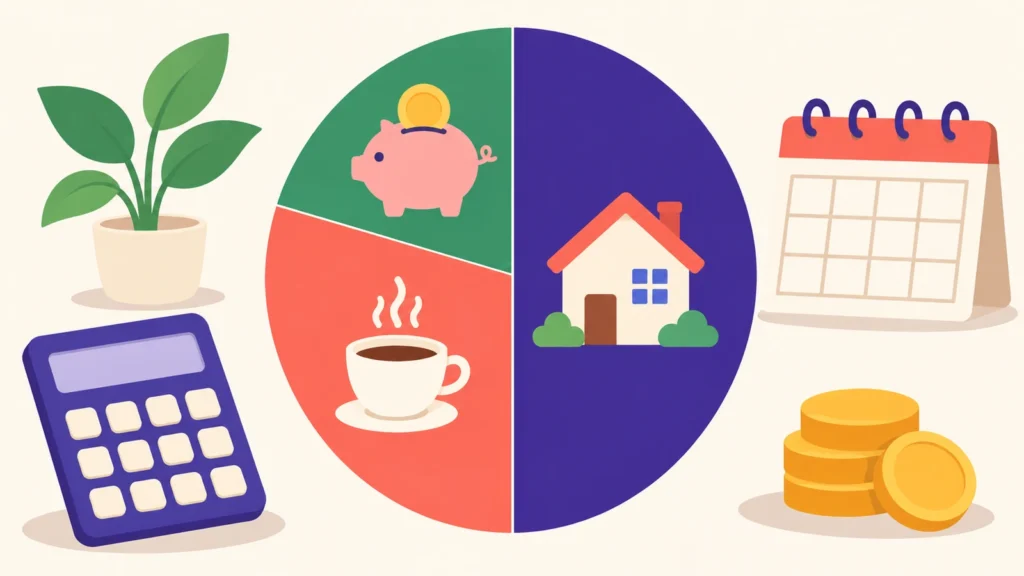
The 50/30/20 budget splits your monthly take-home pay into three parts: 50% for needs, 30% for wants, and 20% for savings and extra debt payments. If you bring home $4,000 a month, that is $2,000 for needs, $1,200 for wants and $800 for savings. It is one of the simplest budgets to start because you only track three numbers.
The rule was made popular by Elizabeth Warren and her daughter Amelia Warren Tyagi in their 2005 book All Your Worth. It matters because many households still have little cushion: in 2025, only 63% of US adults said they would cover a $400 emergency expense with cash or its equivalent, according to the Federal Reserve’s household survey. Here is how to set up the budget and adjust it for real life.
How does the 50/30/20 rule work?
| Category | Share of take-home pay | What goes in it |
|---|---|---|
| Needs | 50% | Rent or mortgage, utilities, groceries, insurance, minimum debt payments, transportation to work, child care |
| Wants | 30% | Dining out, streaming, travel, hobbies, shopping, upgrades like a nicer phone plan |
| Savings and debt | 20% | Emergency fund, retirement contributions, investing, extra payments above the minimum on debt |
A simple test for needs versus wants: would you still have to pay it if you lost your job? If yes, it is a need. If you could cancel it, it is a want.
What does 50/30/20 look like in dollars?
| Monthly take-home pay | Needs (50%) | Wants (30%) | Savings and debt (20%) | Saved per year |
|---|---|---|---|---|
| $2,500 | $1,250 | $750 | $500 | $6,000 |
| $3,500 | $1,750 | $1,050 | $700 | $8,400 |
| $4,000 | $2,000 | $1,200 | $800 | $9,600 |
| $5,000 | $2,500 | $1,500 | $1,000 | $12,000 |
| $6,500 | $3,250 | $1,950 | $1,300 | $15,600 |
| $8,000 | $4,000 | $2,400 | $1,600 | $19,200 |
A real example: Maya’s budget
Maya is a made-up example. She brings home $4,000 a month after taxes. Here is how her spending fits:
| Needs ($2,000 budget) | Cost |
|---|---|
| Rent | $1,250 |
| Utilities and internet | $180 |
| Groceries | $350 |
| Car insurance and gas | $170 |
| Phone (basic plan) | $50 |
| Total needs | $2,000 |
Wants ($1,200): restaurants and coffee $350, streaming and apps $60, clothes $150, gym $40, fun money and weekend trips $600.
Savings ($800): $300 to her emergency fund in a high-yield savings account, $300 to her Roth IRA, and $200 extra toward her credit card balance.
In one year, Maya builds a $3,600 emergency fund, invests $3,600 for retirement, and pays off $2,400 of card debt, without giving up eating out.
How do you set up a 50/30/20 budget? 5 steps
- Find your take-home pay. Use the amount that hits your bank account each month. If 401(k) contributions come out of your paycheck, you can count them toward your 20%.
- List your needs using last month’s bank and card statements. Add them up. Free worksheets and tools from the federal government’s MyMoney.gov can help.
- Do the math. Multiply your take-home pay by 0.5, 0.3 and 0.2.
- Automate savings first. Set an automatic transfer for your 20% on payday, so you save before you spend.
- Use separate accounts or cards. Pay needs from checking, wants from one card or a second account, and keep savings out of sight.
What if your needs are more than 50%?
That is very common, especially in expensive cities. In 2025, the average US household spent 33.9% of its spending on housing alone, plus 16.5% on transportation and 13.0% on food, according to the Bureau of Labor Statistics. If your needs run high, try these:
- Adjust the split. 60/20/20 (needs/wants/savings) or 70/20/10 are fine starting points. The goal is to save something every month.
- Cut the biggest needs first. Shop car and home insurance every year, switch to a cheaper phone plan, and review subscriptions you pay for “just in case.”
- Raise income. A raise, side income or a roommate often helps more than trimming small costs.
- Revisit housing when your lease renews. Use our How Much House Can I Afford? guide if you plan to buy.
Where should your 20% go first?
- A starter emergency fund of $1,000 to $2,000 in a high-yield savings account.
- Your full employer 401(k) match, because it is free money.
- High-interest debt, like credit cards. Paying it down also lifts your credit score; see How to Raise Your Credit Score.
- A full emergency fund of 3 to 6 months of needs.
- Retirement and investing, using the limits in 401(k) and IRA Limits for 2027, often in low-cost index funds.
Is the 50/30/20 budget right for you?
It works well if you want a simple system, have a steady paycheck, and do not want to track every coffee.
Try something else if your income changes a lot month to month (try budgeting from your lowest month), or you are paying off big debts fast (a zero-based budget, where every dollar gets a job, gives more control).
Want help? Free AI tools can sort your expenses for you. Paste a list of last month’s spending into a chatbot and ask it to group it into needs, wants and savings. See Best Free AI Tools for options, and never share account numbers.
Frequently asked questions
Is 50/30/20 based on gross or net income?
Net, meaning your take-home pay after taxes. Retirement contributions taken from your paycheck can count toward the 20%.
Is debt a need or savings?
Minimum payments are needs. Anything extra you pay to get out of debt faster counts toward the 20%.
Is 20% enough to save for retirement?
It is a solid baseline. If you started saving late, aim higher when you can.
What app can I use?
Your bank’s spending tools or a simple spreadsheet work fine. The method matters more than the app.
This article is for information only and is not financial advice.
What to watch next
- January 2027: New year, new raises and new tax brackets. Recalculate your 50/30/20 numbers with your first paycheck. See Tax Brackets 2026 and 2027.
- Every 6 months: Review needs like insurance and phone plans for cheaper options.