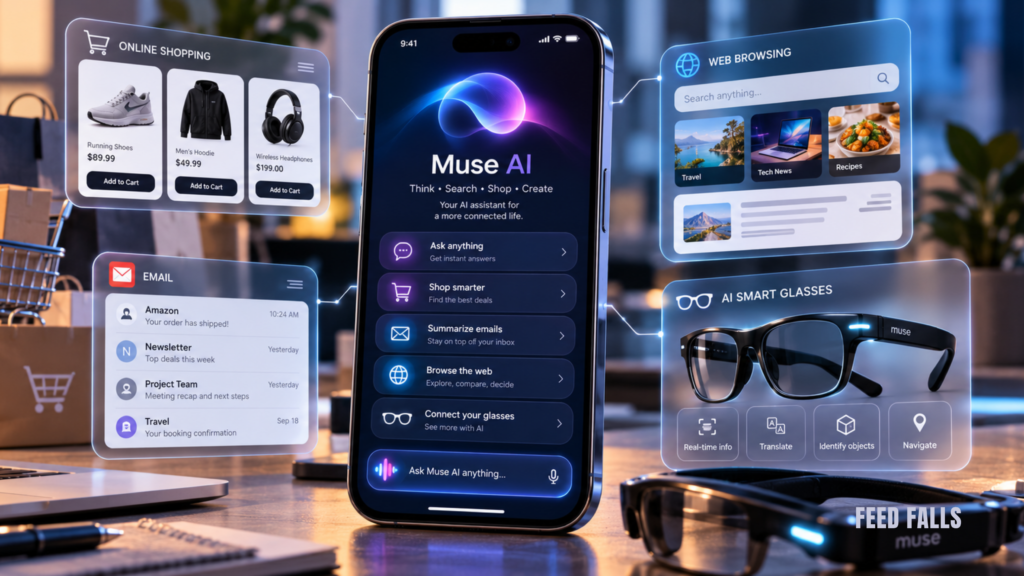
Muse is Meta’s personal AI agent, and as of November 5, 2026, you can talk to it out loud and see it as an animated avatar. Meta rolled out real-time voice conversations and expressive avatars in the Muse app in the US, then added a customization feature called Spaces on November 6. Muse can still take actions for you, including browsing the web, handling tasks, helping with purchases, sending emails and creating documents.
Meta first launched Muse on September 8, 2026. At Meta Connect on September 23, CEO Mark Zuckerberg outlined a business model in which Muse could eventually generate revenue by taking a small fee from transactions it helps complete. The November updates make it feel less like a chatbot and more like an assistant you talk to.
What’s new in Muse in November 2026?
Meta shipped four changes in two days:
- Voice conversations (Nov. 5). Tap the phone icon in the top-right corner of the Muse app to start talking. You can interrupt Muse mid-answer, and it keeps working on tasks in the background while you talk. There are “hundreds of voices” to choose from, and you can switch any time, according to Meta.
- Expressive avatars (Nov. 5). You can use voice only, show an animated avatar next to the chat, or go full screen for a face-to-face style conversation. The avatar reacts while it listens and speaks.
- Spaces (Nov. 6). A “space” is a custom tool you create inside Muse just by describing it, such as a holiday gift tracker, a daily word game or a planning board. You can pin spaces to the sidebar or main tabs, and connected apps keep them updated in the background. Meta says Spaces is available everywhere Muse is.
- Smarter models (Nov. 6). Meta is rolling out specialized versions of its models to Muse and Meta AI. It says its internal Personal Superintelligence Index score rose from 38% to 47%, and that Muse now completes tasks using critical context 90% of the time, up from 76%, per Meta’s research blog. These are Meta’s own benchmarks, not independent tests.
| Feature | Status (Nov. 8, 2026) | Where |
|---|---|---|
| Voice chat | Rolling out | Muse app on mobile, web and Mac, US first |
| Animated avatar | Rolling out | Same as voice |
| Spaces | Available | Everywhere Muse is available |
| Voice on Meta AI glasses | “Coming soon,” no date | AI glasses and Muse Charm |
Meta says avatar responses start about 870 milliseconds after you stop talking, and generated avatar video carries an invisible Meta Video Seal watermark, per its research team.
What Is Muse?
Muse is Meta’s personal AI agent. Meta describes it as a system designed to take action rather than simply respond to prompts.
Users can tell Muse what they want accomplished, and the agent can work through the task using its own virtual computer environment. It can open websites, fill out forms, coordinate information and continue working on longer tasks after the user leaves the app.
For example, Muse can potentially help with tasks such as:
- Planning a trip
- Booking travel
- Sending an email
- Creating documents
- Organizing information
- Shopping online
- Monitoring certain tasks
- Developing plans around longer-term goals
The distinction is important. A conventional chatbot might tell you how to book a flight. An AI agent such as Muse is intended to actually help carry out the process.
Related: Claude Duet: What Anthropic’s New AI Agent Does, What It Costs and Who Can Get It · Gemini AI Hack: How Google’s AI Breached Three Real Companies · What Is Hugging Face? A Simple Guide to the AI Platform
Is Muse free, and who can use it?
Muse is for adults 18 and older. Voice and avatars are launching in the US first, and Meta has not said when other countries will get them. Meta has not announced a separate price for voice. Zuckerberg has said Meta expects Muse to stay free for a large amount of usage, with revenue coming from small fees on transactions it helps complete.
How Does Muse Work?
Meta built Muse around a dedicated virtual machine called Muse Secure VM. The environment is designed to isolate the agent and the user’s data while allowing Muse to interact with websites and connected services.
Meta says users decide which services Muse can access and what permissions it receives. For example, users can control whether Muse can merely read email or also send messages on their behalf. The company also says Muse requests approval before sensitive actions such as sending an email or making a purchase.
This permission model is important because an agent that can act independently needs substantially more access than a chatbot that only produces answers.
Muse Can Continue Working
Muse isn’t limited to a single conversation. Meta says the agent can continue working on longer-running tasks after a person closes the app and return when circumstances change or when it needs approval for an action. With the new voice mode, it can also keep working on a task while you talk to it about something else.
Muse Is Becoming a Shopping Agent
Shopping is one of the most important parts of Meta’s strategy for Muse.
At Meta Connect, Meta announced integrations involving retailers and services including Walmart, Best Buy, Gap, Sephora, Wayfair and American Eagle. Expedia is being added for travel, while Instacart is being integrated for grocery shopping. PayPal support was also announced.
Meta said Muse can use Link, built by Stripe, during checkout. Meta also said Shop Pay is coming and that 1Password support will allow Muse to work with existing logins.
Instead of searching several websites, comparing products manually and completing checkout themselves, consumers could increasingly ask an agent to perform much of the process.
How Meta Plans to Make Money From Muse
Mark Zuckerberg said Meta expects Muse to remain free for a large amount of usage while eventually generating revenue through a small fee on transactions. That gives Meta a potential revenue stream that differs from its traditional advertising model.
User asks Muse to buy something → Muse finds or facilitates the purchase → transaction occurs → Meta receives a small fee.
If an agent becomes the intermediary deciding which products, services or merchants to present, businesses may have to adapt to a new form of digital discovery. It is also a test of whether consumer AI can pay for itself at a time when companies are taking a harder look at AI spending.
When Is Muse Coming to Meta’s AI Glasses?
Meta announced on September 23 that Muse is coming to its AI glasses, allowing users to interact with the agent hands-free. In its November 5 voice announcement, Meta said voice conversations with Muse are “coming soon” to AI glasses and Muse Charm, but it did not give a date.
This is part of Meta’s broader strategy around AI-powered wearables, which also includes new glasses across its Ray-Ban, Oakley and Meta Glasses lines.
Is Muse Safe to Use? Privacy Questions
An agent that can send emails, access files, browse websites and make purchases potentially handles much more sensitive information than a conventional chatbot.
Meta says users remain in control of connected services and permissions. It also says Muse provides an audit trail showing what it has done and what it plans to do, and that passwords and payment information are kept in secure storage rather than being visible to Muse itself.
Meta has also announced plans for a Confidential VM, where the entire virtual machine, including user data and conversations, would be encrypted with a key controlled by the user. Meta says this is planned for later in 2026.
One gap to note: Meta’s November voice announcement does not say how long voice recordings are kept or whether they are used to train its models. Check Muse’s privacy settings before using voice for anything sensitive.
Does Muse Work on Every Website?
No. AI agents need access to websites and services to complete tasks, but companies may not want automated agents interacting with their systems in the same way as human users. CNN reported that Amazon has blocked Muse from accessing its shopping platform, highlighting the tension that could develop between AI agents and established internet businesses.
How Is Muse Different From a Regular AI Chatbot?
| Traditional AI chatbot | Muse |
|---|---|
| Answers questions | Performs tasks |
| Primarily generates information | Can interact with websites and services |
| User performs most actions | Agent can perform actions |
| Usually session-based | Can work on longer-running tasks |
| Mostly text | Real-time voice and an animated avatar |
| Limited permissions | Can connect to selected services |
The distinction doesn’t mean Muse can accomplish everything autonomously. Meta’s system still requires user permissions and approval for certain sensitive actions. But the direction is clear: AI companies are moving from systems that tell users what to do toward systems that can do parts of the work for them.
Why Does Muse Matter?
Agentic AI is judged on a new metric: how effectively it completes real-world tasks. Muse gives Meta a way to connect AI with commerce, messaging, computers and wearable devices, and voice makes it far more natural to use on the go.
Its early adoption has already attracted attention. Yahoo Finance reported that Muse reached the top position on both Apple’s App Store and Google’s Play Store shortly after its launch, while Sensor Tower estimated that the app reached 560,000 daily active users after 11 days. Those figures are an early snapshot rather than proof of long-term success.
What to Watch Next
- November 2026: how quickly voice and avatars reach all US users, and whether Meta names a date for other countries.
- November 27 to December 1, 2026 (Black Friday to Cyber Monday): the first major shopping weekend for Muse’s checkout partners, including Walmart, Best Buy and PayPal.
- By December 31, 2026: Meta’s promised Confidential VM, and the “coming soon” voice launch on AI glasses and Muse Charm.