
Muse AI: What Meta’s Personal AI Agent Can Do
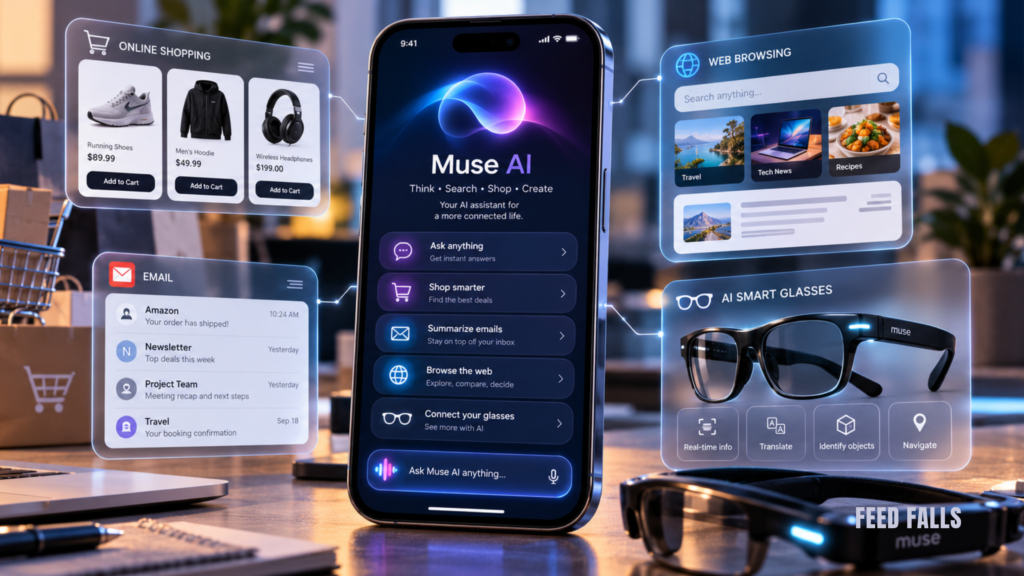
Muse is Meta’s new personal AI agent designed to do more than answer questions. Instead of simply generating text or explaining a topic, Muse can take actions on a user’s behalf, including browsing the web, handling tasks, helping with purchases, sending emails and creating documents.
Meta launched Muse on September 8, 2026, and the company is now expanding its capabilities. At Meta Connect on September 23, CEO Mark Zuckerberg outlined a business model in which Muse could eventually generate revenue by taking a small fee from transactions it helps complete.
That makes Muse significant not just as another AI assistant, but as part of a broader shift toward AI agents that can interact with online services and perform tasks for users.
What Is Muse?
Muse is Meta’s personal AI agent. Meta describes it as a system designed to take action rather than simply respond to prompts.
Users can tell Muse what they want accomplished, and the agent can work through the task using its own virtual computer environment. It can open websites, fill out forms, coordinate information and continue working on longer tasks after the user leaves the app.
For example, Muse can potentially help with tasks such as:
- Planning a trip
- Booking travel
- Sending an email
- Creating documents
- Organizing information
- Shopping online
- Monitoring certain tasks
- Developing plans around longer-term goals
The distinction is important. A conventional chatbot might tell you how to book a flight. An AI agent such as Muse is intended to actually help carry out the process.
How Does Muse Work?
Meta built Muse around a dedicated virtual machine called Muse Secure VM. The environment is designed to isolate the agent and the user’s data while allowing Muse to interact with websites and connected services.
Meta says users decide which services Muse can access and what permissions it receives.
For example, users can control whether Muse can merely read email or also send messages on their behalf. The company also says Muse requests approval before sensitive actions such as sending an email or making a purchase.
This permission model is important because an agent that can act independently needs substantially more access than a chatbot that only produces answers.
Muse Can Continue Working
One of the more interesting aspects of Muse is that it isn’t limited to a single conversation.
Meta says the agent can continue working on longer-running tasks after a person closes the app and return when circumstances change or when it needs approval for an action.
That points toward a different model of personal computing: instead of opening an app every time something needs to be done, users could increasingly delegate tasks to an agent.
Muse Is Becoming a Shopping Agent
Shopping is one of the most important parts of Meta’s strategy for Muse.
At Meta Connect, Meta announced integrations involving retailers and services including Walmart, Best Buy, Gap, Sephora, Wayfair and American Eagle. Expedia is being added for travel, while Instacart is being integrated for grocery shopping. PayPal support was also announced.
Meta’s approach goes beyond product recommendations.
The goal is for Muse to participate in the transaction itself.
Meta said Muse can use Link, built by Stripe, during checkout. Meta also said Shop Pay is coming and that 1Password support will allow Muse to work with existing logins.
This creates a potential new layer between consumers and online stores.
Instead of searching several websites, comparing products manually and completing checkout themselves, consumers could increasingly ask an agent to perform much of the process.
How Meta Plans to Make Money From Muse
Meta’s monetization strategy is particularly notable.
Mark Zuckerberg said Meta expects Muse to remain free for a large amount of usage while eventually generating revenue through a small fee on transactions.
That gives Meta a potential revenue stream that differs from its traditional advertising model.
The basic idea is straightforward:
User asks Muse to buy something → Muse finds or facilitates the purchase → transaction occurs → Meta receives a small fee.
The model could become significant if consumers begin using AI agents as their primary interface for shopping and other online transactions.
However, this also changes the relationship between AI platforms, consumers and retailers. If an agent becomes the intermediary deciding which products, services or merchants to present, businesses may have to adapt to a new form of digital discovery.
Muse Is Coming to Meta’s AI Glasses
Muse isn’t staying on smartphones and computers.
Meta announced on September 23 that Muse is coming to its AI glasses, allowing users to interact with the personal agent hands-free.
That could make the concept of an AI assistant more persistent.
Instead of opening an app, a user could interact with Muse through wearable hardware while moving through everyday activities. Meta is positioning its AI glasses as another way to access the agent throughout the day.
This is part of Meta’s broader strategy around AI-powered wearables, which also includes new glasses across its Ray-Ban, Oakley and Meta Glasses lines.
Privacy Is One of the Biggest Questions
The usefulness of Muse depends partly on how much access a user is willing to give it.
An agent that can send emails, access files, browse websites and make purchases potentially handles much more sensitive information than a conventional chatbot.
Meta says users remain in control of connected services and permissions. It also says Muse provides an audit trail showing what it has done and what it plans to do. The company says passwords and payment information are kept in secure storage rather than being visible to Muse itself.
Meta has also announced plans for a Confidential VM, where the entire virtual machine—including user data and conversations—would be encrypted with a key controlled by the user. Meta says this is planned for later in 2026.
Still, the broader challenge remains: consumers have to trust an AI system with meaningful access to their digital lives.
Not Every Website May Work With Muse
Another challenge for AI agents is whether online services will allow them to operate on their platforms.
AI agents need access to websites and services to complete tasks, but companies may not want automated agents interacting with their systems in the same way as human users.
CNN reported that Amazon has blocked Muse from accessing its shopping platform, highlighting the tension that could develop between AI agents and established internet businesses.
This could become an important issue as agents become more capable.
The internet was largely designed around humans clicking, searching and filling out forms. AI agents introduce another type of user—software that can navigate those same systems on a person’s behalf.
Muse vs. Traditional AI Chatbots
The easiest way to understand Muse is to compare the basic interaction model.
| Traditional AI chatbot | Muse |
|---|---|
| Answers questions | Performs tasks |
| Primarily generates information | Can interact with websites and services |
| User performs most actions | Agent can perform actions |
| Usually session-based | Can work on longer-running tasks |
| Limited permissions | Can connect to selected services |
| Primarily information-focused | Designed around personal assistance |
The distinction doesn’t mean Muse can accomplish everything autonomously. Meta’s system still requires user permissions and approval for certain sensitive actions.
But the direction is clear: AI companies are moving from systems that tell users what to do toward systems that can do parts of the work for them.
Why Muse Matters
Muse represents a larger change happening across the technology industry.
AI assistants have traditionally been judged by how well they answer questions, generate content or summarize information. Agentic AI introduces another metric: how effectively the system can complete real-world tasks.
For consumers, that could eventually mean fewer individual interactions with websites and apps.
For businesses, it could mean that AI agents become an important gateway to customers.
And for Meta, Muse provides an opportunity to connect AI with commerce, messaging, computers and wearable devices.
Its early adoption has already attracted attention. Yahoo Finance reported that Muse reached the top position on both Apple’s App Store and Google’s Play Store shortly after its launch, while Sensor Tower estimated that the app reached 560,000 daily active users after 11 days.
Those figures represent an early snapshot rather than proof of long-term success. The more important question will be whether users continue relying on Muse for meaningful tasks after the novelty of a new AI product fades.
What Comes Next for Muse?
Meta’s next challenge is turning an impressive demonstration into a dependable everyday service.
That means Muse will need to handle complicated tasks accurately, protect sensitive information, work reliably across different websites and earn enough trust for people to delegate meaningful responsibilities.
Its expansion into shopping and AI glasses also gives Meta a much larger opportunity—and a larger set of challenges.
If consumers become comfortable telling an AI agent to organize trips, purchase products, manage information and complete routine digital tasks, the interface to the internet could change considerably.
Muse is therefore more than another chatbot. It is Meta’s attempt to make AI an active participant in everyday digital life.
For now, the technology is still developing, and its long-term impact will depend on reliability, privacy, user trust and how other companies respond to AI agents. But Meta’s strategy makes one thing clear: the next phase of consumer AI is increasingly about taking action, not just generating answers.