
Tesla Cybercab Launches in Austin: Availability, Features and What’s Next
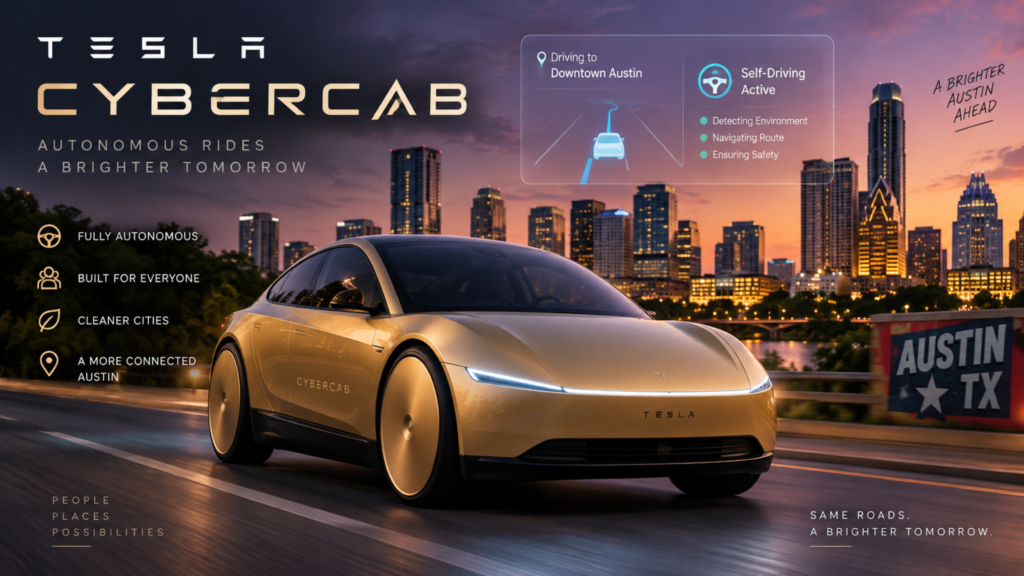
Tesla has begun introducing its purpose-built Cybercab robotaxi in Austin, Texas, marking a major step in its plan to build a driverless ride-hailing network. The two-seat electric vehicle has no steering wheel or pedals and is initially operating in a limited area alongside Tesla’s existing Robotaxi fleet.
The launch is important, but it is not yet a nationwide rollout. Availability remains restricted, the initial fleet is small, and U.S. regulators are examining how the vehicle fits within existing safety rules.
What Is the Tesla Cybercab?
The Tesla Cybercab is a two-seat autonomous electric vehicle designed specifically for robotaxi service. Unlike a conventional Tesla, it does not include a steering wheel, pedals, or traditional driver controls. Instead, it relies on Tesla’s autonomous-driving software and onboard cameras to navigate roads without a human driver inside the vehicle.
Tesla first revealed the Cybercab concept in October 2024. The production vehicle is intended to serve as the main workhorse of the company’s future Robotaxi network rather than as a regular consumer car.
The vehicle has a distinctive gold-colored exterior, gull-wing-style doors, and a compact cabin designed for two passengers. Its limited seating capacity separates it from larger robotaxi vehicles and could make it more suitable for individual trips than for families or groups.
When Did the Cybercab Launch?
Tesla held a closed launch event in Austin on Thursday, September 3, 2026. The event included invited guests and selected Robotaxi riders, but Tesla did not provide the kind of broad public livestream often associated with its major product announcements.
The Cybercab then began joining Tesla’s Robotaxi service in selected parts of Austin. Public access was expected to expand after the launch event, although the company has not announced a nationwide availability date or a broad commercial rollout schedule.
Tesla’s existing autonomous ride service already uses modified Model Y vehicles in parts of Texas and Florida. The Cybercab represents the next stage of that program because it was designed from the beginning to operate without a driver.
How Many Cybercabs Are Operating?
The initial deployment is relatively small. About 45 Cybercabs were registered in Texas, forming part of a broader Tesla autonomous fleet of approximately 420 vehicles. Most of the wider fleet still consists of Model Y vehicles rather than the new purpose-built robotaxi.
That limited fleet means that even if rides are available to the public, customers should not expect the same coverage or availability as a conventional ride-hailing service. Wait times, service areas, and the number of Cybercabs available at any moment may vary.
Tesla has discussed significantly increasing production, including a potential annual manufacturing capacity of 125,000 Cybercabs. However, manufacturing capacity is not the same as the number of vehicles already operating in public service.
How Does a Cybercab Ride Work?
A customer can request a ride through Tesla’s Robotaxi service, similar in concept to booking a trip through Uber or Lyft. The rider enters the vehicle, selects the destination, and allows the autonomous system to handle the journey.
The most visible difference is that there is no human driver to take control. Tesla says the vehicle is designed to operate autonomously, while remote personnel may provide assistance when necessary. This does not mean a remote operator manually drives every vehicle throughout the trip; rather, remote support is part of the wider operating system for handling unusual situations.
The launch also highlights an important distinction between Tesla’s consumer Full Self-Driving technology and a fully driverless robotaxi. Tesla’s consumer FSD system remains a supervised driving feature, while the Cybercab is being deployed as a dedicated autonomous service vehicle.
What Makes the Cybercab Different From Waymo?
Tesla is entering a market where Waymo already has a substantial operational lead. Waymo operates thousands of driverless vehicles across multiple U.S. cities, while Tesla’s unsupervised robotaxi network is still much smaller and more geographically limited.
The companies also use different technical approaches:
- Tesla: Relies primarily on camera-based perception and neural-network software.
- Waymo: Uses a broader sensor system that includes lidar, radar, and cameras.
- Tesla Cybercab: Has no steering wheel or pedals.
- Waymo vehicles: Generally retain more conventional vehicle controls and are built around a different autonomous-driving architecture.
Tesla argues that a camera-focused system can reduce hardware costs and support large-scale deployment. Critics question whether cameras alone can provide sufficient redundancy in difficult conditions such as glare, fog, heavy rain, or poor visibility. The Cybercab’s performance in real-world service will be more important than its launch demonstrations.
What Are the Main Benefits?
The Cybercab is designed around the economics of autonomous transportation rather than private car ownership.
Lower operating costs
A vehicle that does not require an onboard driver could reduce the cost of each trip over time. Tesla has previously discussed a long-term operating-cost target of around $0.20 per mile, although actual customer fares and profitability will depend on maintenance, charging, insurance, supervision, cleaning, financing, and utilization.
Purpose-built design
The Cybercab does not need to accommodate a driver. That allows Tesla to design the interior around passengers, storage, charging, and autonomous operation instead of traditional driving requirements.
Potential for continuous service
Robotaxis can theoretically operate for much longer periods than privately owned vehicles, provided they can charge, receive maintenance, and remain available in areas with demand. Tesla executives have indicated that the company wants to expand toward round-the-clock operation, but the timing and scale of that expansion remain uncertain.
A new business model for Tesla
Tesla’s long-term vision extends beyond selling electric vehicles. The company wants to earn recurring revenue from autonomous rides and potentially allow private owners or business operators to place vehicles into a Tesla-managed network. That model has been discussed for years, but it has not yet been demonstrated at large scale.
What Are the Biggest Concerns?
The Cybercab launch also raises questions that Tesla must answer before expanding widely.
Regulatory approval
The absence of a steering wheel and pedals creates a legal challenge because federal vehicle safety rules generally assume that a vehicle has conventional human controls. The National Highway Traffic Safety Administration has confirmed that it is evaluating Tesla’s rollout and is in contact with the company.
The regulatory review does not automatically mean the Cybercab launch has been stopped. It does mean that Tesla’s ability to expand the vehicle to larger fleets and additional markets may depend on exemptions, approvals, or changes to existing rules.
Safety and reliability
A driverless vehicle must handle pedestrians, cyclists, emergency vehicles, road construction, unusual traffic patterns, and unexpected human behavior. A successful demonstration or a smooth passenger ride does not establish that the system is reliable in every condition.
Tesla’s camera-only approach is another point of debate. The company believes its software and visual data can support autonomous driving, while critics argue that additional sensors provide useful redundancy.
Limited availability
The first fleet is small, and the service is confined to selected areas. This makes the initial launch more of a controlled deployment than a fully mature alternative to taxis or ride-hailing services.
Unclear pricing
Tesla has discussed low operating costs and dynamic pricing, but the company has not established a complete, widely published fare structure for Cybercab rides. A low theoretical operating cost does not necessarily translate into cheaper customer fares, particularly while the fleet is small.
Public trust
Many passengers remain uncomfortable with fully autonomous vehicles. Tesla must convince riders that the Cybercab is safe, predictable, and dependable—not just technologically impressive.
Is the Cybercab Available to Everyone?
The Cybercab is beginning service in limited parts of Austin, but availability should not be confused with unrestricted access across the city or the United States.
The initial rollout is constrained by:
- A small number of Cybercabs
- A limited operating area
- Regulatory oversight
- Vehicle charging and maintenance requirements
- The need to monitor performance in real-world conditions
- Tesla’s gradual expansion of its Robotaxi service
Tesla has not announced a confirmed nationwide launch date. Expansion to other cities will likely depend on vehicle production, local rules, testing, infrastructure, and the company’s ability to demonstrate reliable autonomous operation.
What Happens Next?
The next major test is whether Tesla can move from a highly publicized launch to a dependable commercial service.
Readers should watch for:
- More Cybercabs entering the fleet
- Clearer information about fares and service coverage
- Regulatory decisions involving vehicles without manual controls
- Independent safety and performance data
- Expansion beyond Austin
- Evidence that the service can operate consistently during difficult weather and traffic conditions
Tesla’s success will not be measured only by how many vehicles it produces. It will also depend on utilization, customer satisfaction, safety performance, operating costs, and the company’s ability to scale without creating new regulatory or technical problems.
The Bottom Line
The Tesla Cybercab has moved from concept to limited real-world deployment in Austin, making it one of the most significant milestones in Tesla’s autonomous-driving strategy. But the launch is only an early step.
The vehicle’s steering-wheel-free design, small initial fleet, camera-based technology, and regulatory questions make the rollout different from a conventional car launch. For now, the Cybercab is best understood as a controlled test of Tesla’s larger robotaxi ambitions—not proof that fully autonomous transportation is already ready for widespread use.