
Current Mortgage Rates: 30-Year Fixed Rate at 6.66%
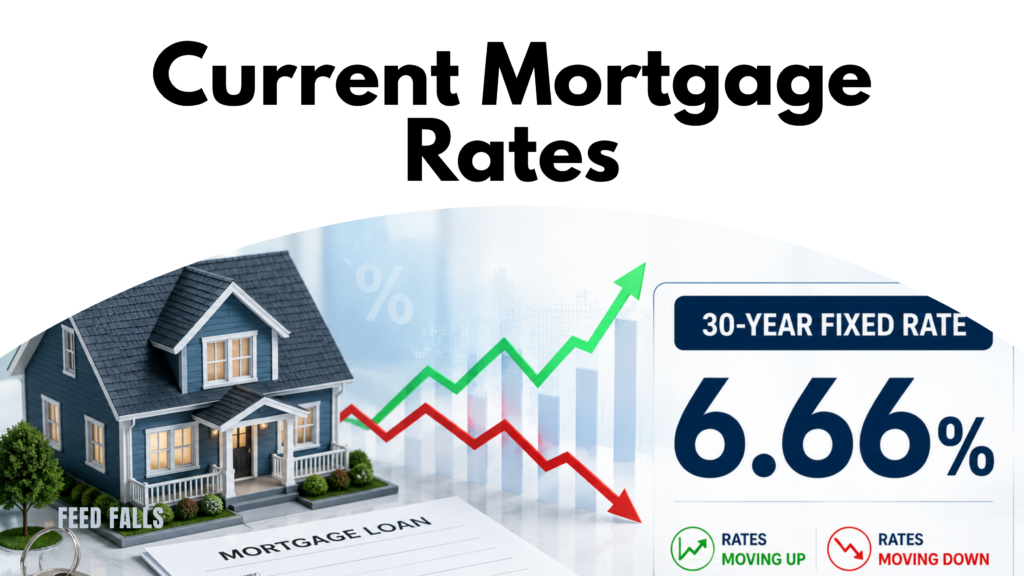
Current mortgage rates remain elevated in late August 2026, with the average 30-year fixed mortgage rate at 6.66% and the average 15-year fixed rate at 5.98%, according to Freddie Mac’s latest Primary Mortgage Market Survey released August 27.
The 30-year rate edged up from 6.65% the previous week and is now close to the 2026 high of 6.69% recorded earlier in August.
Current Mortgage Rates
| Mortgage type | Current average | Previous week |
| 30-year fixed | 6.66% | 6.65% |
| 15-year fixed | 5.98% | 5.95% |
Freddie Mac’s figures represent a national weekly average based on mortgage applications meeting its survey criteria. They are not personalized quotes from a particular lender. Your actual rate can be higher or lower depending on factors such as credit score, down payment, loan type, property and lender.
Mortgage Rates Are Near Their 2026 High
The latest increase is small, but it puts borrowing costs close to the year’s highest levels.
The 30-year average reached 6.69% earlier in August before easing to 6.65% and then moving back to 6.66%. The current rate is also roughly where it was four weeks ago.
Compared with a year ago, the 30-year average is also slightly higher: 6.66% versus 6.56%. The 15-year average is currently 5.98%, compared with 5.69% a year earlier.
Why Are Mortgage Rates Still High?
Mortgage rates don’t move directly with the Federal Reserve’s benchmark interest rate.
Instead, longer-term mortgage rates are heavily influenced by the bond market, particularly the 10-year U.S. Treasury yield. Inflation expectations, economic conditions and investor demand for Treasury securities can therefore affect mortgage pricing.
The 10-year Treasury yield was around 4.66% on August 27, significantly above its late-February level of 3.97%. Higher long-term Treasury yields have helped keep mortgage rates elevated.
Recent economic uncertainty has also contributed to higher bond yields and borrowing costs.
What Does a 6.66% Mortgage Rate Mean for Buyers?
The difference between today’s mortgage rates and the unusually low rates available during the pandemic remains substantial.
For example, on a $400,000 30-year fixed mortgage, a 6.66% interest rate would produce a principal-and-interest payment of roughly $2,571 per month.
That does not include property taxes, homeowners insurance, mortgage insurance or other housing costs.
The calculation also illustrates why even relatively small rate changes matter. A lower mortgage rate can reduce the monthly payment and increase the amount of home a buyer can afford without increasing their housing budget.
Higher Rates Are Weighing on Housing Demand
Elevated mortgage rates are continuing to affect the housing market.
Higher borrowing costs reduce purchasing power, which can encourage potential buyers to postpone a purchase. The Associated Press reported that U.S. existing-home sales slowed again in July, while the housing market has remained weak since mortgage rates began rising from pandemic-era lows.
This creates a difficult environment for buyers: home prices may not fall enough to fully offset the additional cost of financing.
At the same time, homeowners with older mortgages at much lower rates may be reluctant to sell and take on a new loan at today’s rates. That can restrict housing inventory and make the market less fluid.
Should You Wait for Mortgage Rates to Fall?
There is no guaranteed answer.
Waiting could make sense for buyers who are not financially ready or who would struggle with today’s payments. But attempting to predict the exact bottom of mortgage rates can also backfire.
A better approach is to evaluate the purchase based on:
- Your income and monthly budget
- Credit score
- Down payment
- Expected length of ownership
- Home price
- Local housing inventory
- Available mortgage offers
If rates fall substantially after you buy, refinancing may eventually become an option. However, refinancing involves closing costs and is not guaranteed to make financial sense.
Current Mortgage Rates: What to Watch Next
The biggest factors to watch are inflation, Treasury yields and Federal Reserve policy expectations.
Mortgage rates can move before the Fed actually changes its benchmark rate because investors constantly adjust expectations for future economic conditions and monetary policy.
For now, the latest data shows a relatively stable but elevated market. The 30-year average has remained around the mid-6% range rather than making a decisive move lower.
Bottom Line
The latest current mortgage rates show the average U.S. 30-year fixed mortgage at 6.66% and the 15-year fixed mortgage at 5.98% as of August 27, 2026.
The 30-year rate is only slightly above the previous week’s 6.65%, but it remains close to the 2026 high of 6.69%.
For prospective buyers, the key issue is not simply whether rates fall next week. The more important question is whether a mortgage at today’s rate fits comfortably within the household budget.