
Tesla Roadster 2026: Reveal Date, Specs, Price and Release Plans
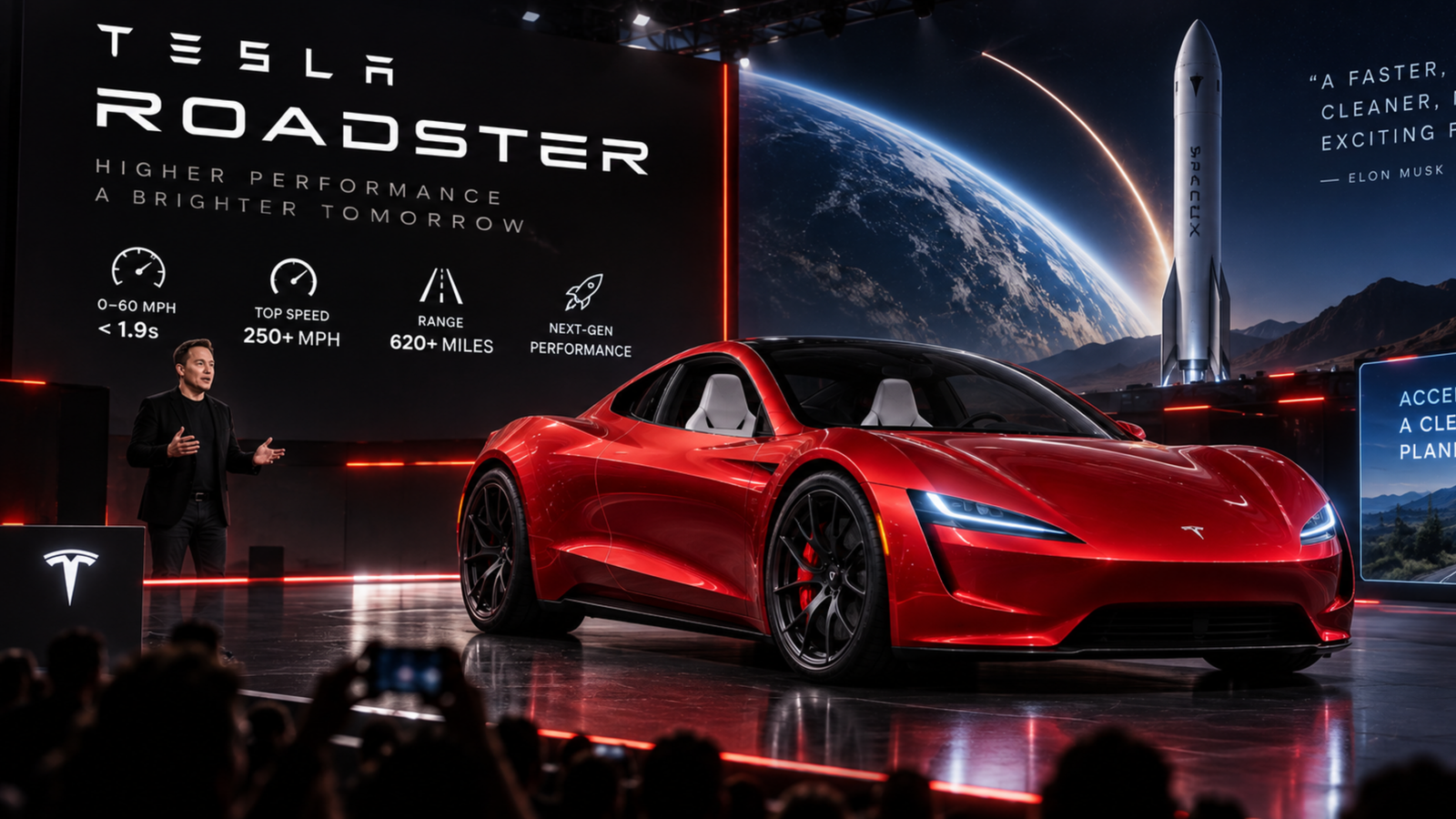
Tesla’s long-delayed second-generation Tesla Roadster is finally approaching another major milestone. Tesla and CEO Elon Musk have announced that the electric sports car will be unveiled on October 1, 2026, nearly nine years after the model was first shown in 2017.
The announcement is significant, but an important distinction remains: October 1 is a reveal date, not a confirmed customer delivery date. Tesla has not yet provided a definitive production schedule for the new Roadster. That makes the upcoming event important for potential buyers, reservation holders and investors who have been waiting years to see whether Tesla’s ambitious performance claims will become a production reality.
When Will the Tesla Roadster Be Revealed?
Tesla has scheduled the next-generation Roadster reveal for October 1, 2026.
The date was announced by Tesla and Musk on September 12, accompanied by a “Go for launch” teaser. Tesla has also placed a countdown on the Roadster section of its website.
The timing comes after several previous Roadster targets failed to materialize. The second-generation car was originally unveiled in November 2017, with Tesla initially targeting production around 2020. The project subsequently experienced repeated delays.
That history means the October event will be watched closely. A formal unveiling would be a significant step, but buyers will still need answers about production, final specifications, pricing and deliveries.
What Is the Tesla Roadster?
The new Roadster is intended to be Tesla’s high-performance electric sports car and the successor to the original Roadster, which helped establish the company as an automaker.
The original Roadster was produced from 2008 through 2012 and was based on the Lotus Elise platform. It demonstrated that a battery-powered sports car could deliver serious performance, helping Tesla establish its identity before the Model S and later mass-market vehicles.
The second-generation Roadster takes a very different approach. Tesla has positioned it as an electric supercar capable of competing with extremely high-performance gasoline-powered vehicles while offering substantially greater electric range than most sports cars.
Tesla Roadster Specs: What Has Tesla Promised?
Tesla’s current Roadster website lists several headline figures:
| Specification | Tesla’s current published figure |
| 0 to 60 mph | 1.9 seconds |
| Top speed | More than 250 mph |
| Claimed range | 620 miles |
| Seating | Four |
| Roof | Removable glass roof |
Tesla describes the Roadster as an all-electric supercar designed around performance and aerodynamic efficiency. Its website also says the car is designed to seat four people, unusual for a vehicle positioned against traditional two-seat supercars.
However, these numbers should be treated as Tesla’s stated targets rather than independently verified production specifications. The vehicle has not yet entered regular production, and the final production version could differ from the prototypes and earlier specifications.
The 1.9-second acceleration claim
The headline performance figure is a claimed 0-to-60 mph time of 1.9 seconds.
When Tesla introduced the Roadster in 2017, the company said the car would accelerate from zero to 60 mph in 1.9 seconds and exceed 250 mph. Those figures helped position the Roadster against some of the world’s fastest production cars.
The important question now is whether Tesla can deliver comparable performance in a production vehicle while meeting regulatory requirements, maintaining reliability and providing the range it has promised.
What About the 620-Mile Range?
Tesla currently advertises 620 miles of range for the Roadster.
That figure would be exceptional for a high-performance electric car. Sports cars generally prioritize acceleration, handling and power over maximum driving range, while large battery packs add weight.
The original 2017 presentation referenced a 200-kWh battery pack and a 620-mile range claim.
But the final battery configuration, testing standard and production specifications remain important unanswered questions. Until an actual production vehicle is tested under an established range procedure, the 620-mile figure should be considered a Tesla claim rather than a confirmed real-world result.
Will the Roadster Really Have SpaceX Technology?
One of the most unusual aspects of the Roadster story is Tesla’s proposed SpaceX performance package.
Musk has previously discussed using cold-gas thrusters around the vehicle to improve acceleration and potentially provide other performance benefits. More recent Roadster teasers have renewed speculation that some form of SpaceX-related technology could appear on the production car.
This is an area where it is particularly important to separate confirmed information from speculation.
Tesla has not yet provided a complete production specification confirming that a thruster-equipped Roadster will be available to ordinary customers. The October reveal should provide a clearer answer.
If the technology does appear, it would make the Roadster considerably different from conventional electric sports cars. If it does not, the car would still be positioned as an extremely high-performance EV based on its conventional electric drivetrain.
How Much Will the Tesla Roadster Cost?
The Roadster was originally announced with a $200,000 starting price, while the Founders Series was priced at $250,000. Tesla also previously accepted substantial reservation deposits.
Today, however, the final production price has not been confirmed.
That distinction matters because nearly nine years have passed since the original announcement. Battery costs, manufacturing economics, vehicle specifications and Tesla’s overall product strategy have changed considerably since 2017.
For now, $200,000 should be treated as the historical announced starting price, not a confirmed 2026 production price.
When Will the Tesla Roadster Go on Sale?
This is still one of the biggest unanswered questions.
Tesla has confirmed the October 1 reveal, but the company has not announced a firm customer delivery date. Reuters reported that further information about the vehicle’s capabilities and availability is expected at the October event.
Some industry reporting has pointed toward production in 2027 or later, but that should not be confused with a confirmed Tesla delivery schedule.
The distinction is especially important given the Roadster’s history. Tesla has announced the car years before production, and several previous timelines passed without customer deliveries.
Why Has the Roadster Taken So Long?
The Roadster has repeatedly been pushed behind other Tesla priorities.
Since its 2017 unveiling, Tesla has expanded the Model 3 and Model Y, developed the Cybertruck, invested heavily in battery manufacturing, expanded its energy business and shifted substantial attention toward autonomous driving and robotics.
The Roadster is also expected to be a relatively low-volume vehicle. Morningstar’s September 14 analysis estimates that the model could sell around 2,000 units annually, compared with Tesla’s broader vehicle deliveries in the millions.
That helps explain why the Roadster can be strategically important without being a major volume product.
Why Does the Roadster Matter to Tesla?
The Roadster is more than another vehicle in Tesla’s lineup.
It can serve as a halo car, a vehicle intended to showcase a company’s technology, performance and engineering capabilities.
Morningstar describes the Roadster as Tesla’s new halo vehicle after the company ended production of the Model S and Model X earlier in 2026. Its analysis argues that the Roadster can reinforce Tesla’s technology image even though it is expected to represent only a small fraction of total vehicle sales.
A successful Roadster launch could therefore have an impact beyond the number of cars Tesla actually sells.
It could demonstrate advances in:
- Electric powertrain performance
- Battery technology
- Aerodynamics
- High-speed stability
- Vehicle software
- Manufacturing
- Advanced materials
- Potential SpaceX-derived technology
Tesla Roadster vs. Tesla Cybercab
The Roadster and Cybercab represent almost opposite sides of Tesla’s current strategy.
The Roadster is a premium performance vehicle designed to showcase speed and engineering.
The Cybercab is a two-seat autonomous vehicle designed around Tesla’s robotaxi ambitions.
The contrast is significant. Tesla is simultaneously trying to establish itself as a manufacturer of high-performance electric vehicles and as a company focused on autonomous transportation and artificial intelligence.
The Cybercab has already entered limited commercial service in Austin, while the Roadster remains a pre-production vehicle awaiting its October reveal.
What Should Buyers Watch on October 1?
The most useful information from the reveal will not simply be another acceleration number.
Potential buyers and reservation holders should look for concrete answers to these questions:
- What is the final production design?
- Has Tesla changed the powertrain or battery from the original concept?
- Is the 1.9-second acceleration claim still valid?
- Does the 620-mile range target remain?
- What will the actual starting price be?
- Will the SpaceX package be offered, and how will it work?
- Where will the Roadster be manufactured?
- When will production begin?
- When will the first customer cars be delivered?
- How many vehicles does Tesla expect to produce annually?
Those answers will tell buyers much more than another concept-car demonstration.
Is the Tesla Roadster Worth Waiting For?
That depends on what a buyer wants.
For someone looking for an electric car with extreme performance and exclusivity, the Roadster could be one of the most interesting upcoming EVs.
But prospective buyers should be cautious about making decisions based solely on specifications announced years ago. The vehicle’s development has taken much longer than originally expected, and several of its headline numbers remain unverified in a production vehicle.
The October 1 reveal should reduce some of that uncertainty.
The Bottom Line
The Tesla Roadster is finally approaching the moment Tesla has promised for years: a new-generation reveal on October 1, 2026.
Tesla continues to advertise ambitious targets, including 1.9-second 0-to-60 mph acceleration, a top speed above 250 mph and 620 miles of range. But these remain manufacturer claims until the final production vehicle is revealed and independently tested.
The bigger question is what happens after the reveal. Tesla needs to turn an eight-year-old promise into a manufacturable, certifiable and deliverable sports car.
If it does, the Roadster could become an important halo vehicle for Tesla. If the company announces another distant production timeline, skepticism surrounding the project is likely to continue.