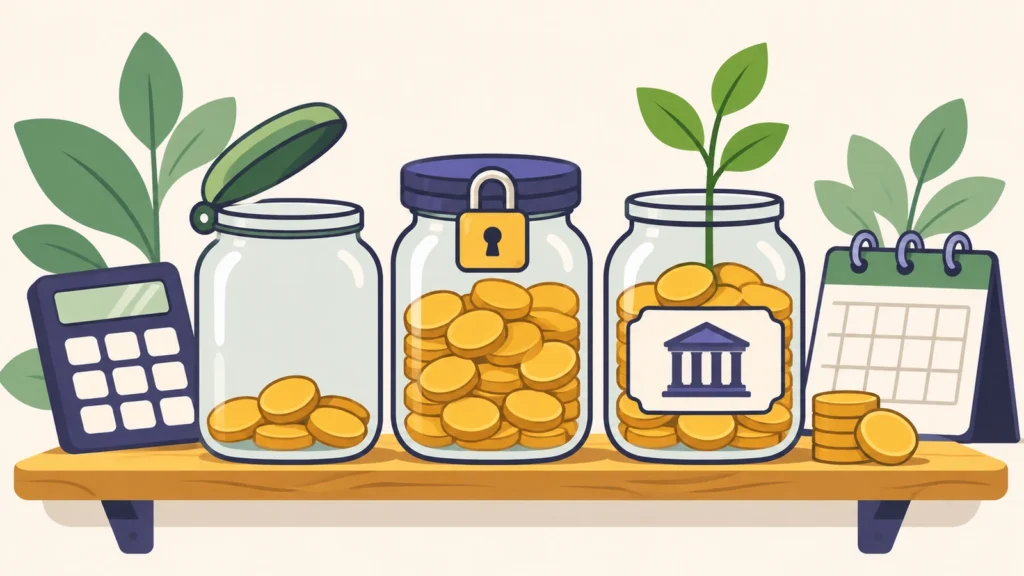
Keep your emergency fund in a high-yield savings account, lock money you will not need for a set time in a CD, and use Treasury bills if you live in a high-tax state or want a government-backed short-term option. Right now, all three pay around 4% or more at the best providers, far above the 0.57% national average savings rate.
Rates updated November 6, 2026. Rates change often, so check before you open an account.
What are the rates right now?
| Option | Typical top rate today | Source |
|---|---|---|
| Average savings account | 0.57% APY | Bankrate, Nov. 5 |
| High-yield savings account | About 4.00% to 4.70% APY | Fortune, Nov. 6 |
| 1-year CD | Up to 4.65% APY (average 2.11%) | Bankrate |
| 5-year CD | Up to 5.00% APY (average 1.78%) | Bankrate |
| 13-week Treasury bill | 4.10% | Treasury yield data, Nov. 5 |
| 52-week Treasury bill | 4.28% | Treasury yield data, Nov. 5 |
The gap between the average account and the best ones is huge. If your cash sits in a big-bank savings account paying close to zero, moving it is one of the easiest money wins there is.
How much does $10,000 earn in one year?
| Where you keep $10,000 | Rate | Interest in 1 year | After 5% state income tax |
|---|---|---|---|
| Average savings account | 0.57% | $57 | $54 |
| High-yield savings account | 4.00% | $400 | $380 |
| 1-year CD | 4.65% | $465 | $442 |
| 52-week Treasury bill | 4.28% | $428 | $428 (no state tax) |
FeedFalls calculation, before federal income tax, which applies to all four. A savings rate can change at any time; the CD and T-bill rates are locked for the term.
What is a high-yield savings account?
A high-yield savings account is a regular savings account, usually at an online bank, that pays much more interest than big branch banks. You can add or withdraw money any time.
- Pros: Easy access, no lock-up period, FDIC insured.
- Cons: The rate can drop whenever the bank chooses, often after the Federal Reserve cuts rates.
- Best for: Emergency funds and savings you may need soon.
What is a CD?
A certificate of deposit (CD) pays a fixed rate for a set term, such as 6 months, 1 year or 5 years. In return, you agree to leave the money alone until the term ends.
- Pros: Your rate is locked even if rates fall. FDIC insured at banks, and similarly insured by the NCUA at credit unions.
- Cons: Taking money out early usually costs a penalty, often several months of interest.
- Best for: Money for a known future date, like a down payment next year or a planned car purchase.
What is a Treasury bill?
A Treasury bill (T-bill) is a short-term loan to the US government, lasting from 4 weeks to 52 weeks. You can buy them at TreasuryDirect starting at $100, or through a brokerage account.
- Pros: Backed by the US government. Interest is exempt from state and local income tax, which helps in high-tax states like California and New York.
- Cons: A little more work to buy and roll over. Selling before maturity in a brokerage can mean a small gain or loss.
- Best for: Larger cash balances, people in high-tax states, and anyone who wants government backing.
Is my money safe?
Yes, if you follow the limits. Bank deposits, including savings accounts and CDs, are insured by the FDIC up to $250,000 per depositor, per insured bank, for each account ownership category (FDIC). Check that any online bank is FDIC insured, or NCUA insured for credit unions. T-bills are not FDIC insured but are backed by the full faith and credit of the US government.
Be careful with fintech apps that are not banks themselves. Make sure the app clearly names its partner bank and explains how your money is insured.
Which should you choose?
| Your goal | Best choice |
|---|---|
| Emergency fund (3 to 6 months of expenses) | High-yield savings |
| Money for a known date 6 to 24 months away | CD or T-bills matching the date |
| You think rates will fall and want to lock today’s rate | CD (longer terms lock it longer) |
| You live in a high-tax state with $20,000+ in cash | T-bills |
| Money you will not touch for 5+ years | Consider investing instead, such as an index fund. See Index Funds Explained |
A simple plan many people use
- Keep 1 month of expenses in checking for bills.
- Keep 3 to 6 months of expenses in a high-yield savings account as your emergency fund.
- Put money for specific goals in CDs or T-bills timed to when you need it.
- Invest money for retirement and goals 5+ years away. Start with 401(k) and IRA limits for 2027.
Saving for a home? Pair this with How Much House Can I Afford? And if you are building a budget from scratch, start with the 50/30/20 rule.
Frequently asked questions
Is interest from savings taxable?
Yes. Interest from savings, CDs and T-bills counts as income for federal tax. T-bill interest is free from state and local income tax.
What is a CD ladder?
You split your money across CDs that end at different times, such as 6, 12, 18 and 24 months. Something matures regularly, so you get access to cash without breaking a CD early.
Will high-yield savings rates go down?
They usually follow the Federal Reserve. If the Fed cuts rates, savings rates tend to drop within weeks, while CD and T-bill rates stay locked until they mature.
Are online banks safe?
Online banks that are FDIC members are protected the same way as branch banks, up to $250,000 per depositor, per bank, per ownership category.
This article is for information only and is not financial advice.
What to watch next
- December 8 to 9, 2026: The Federal Reserve’s next policy meeting. A rate cut would push savings rates down. A hold keeps them steady.
- Early 2027: Banks often adjust promotional savings and CD rates at the start of the year.
- Every Thursday: Track borrowing costs in our Current Mortgage Rates update.