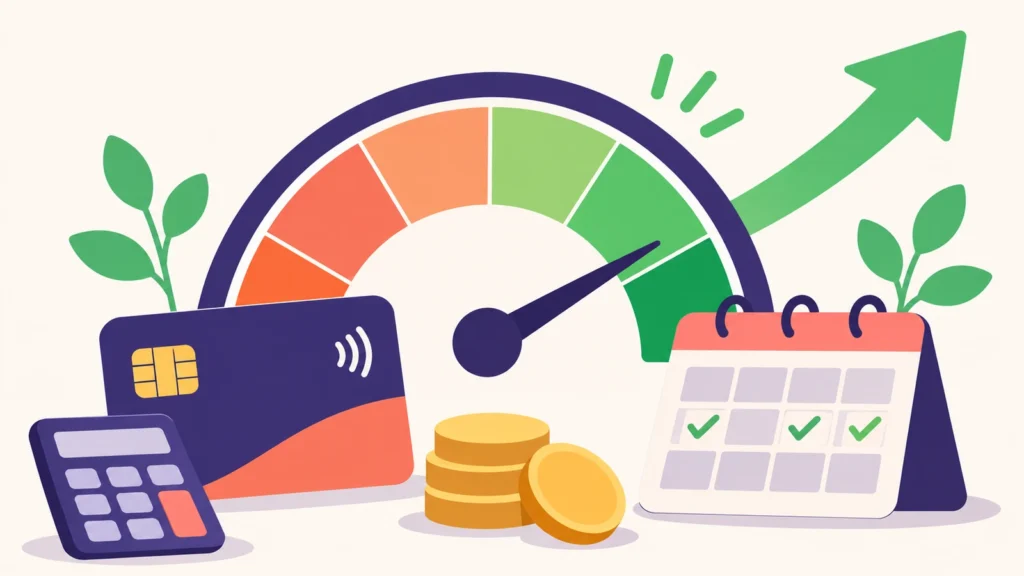
The two fastest ways to raise your credit score are paying every bill on time and lowering how much of your credit card limits you use, ideally under 30% and even better under 10%. Together, payment history and amounts owed make up about 65% of a FICO score. Paying down card balances can lift your score within a month or two, while building a long on-time record raises it steadily over time.
The average FICO score in the US is 714, according to FICO’s August 2026 Credit Insights Report. Here is how to get above it.
What makes up your credit score?
FICO scores range from 300 to 850 and are built from five factors (myFICO):
| Factor | Share of score | What it means | How fast you can change it |
|---|---|---|---|
| Payment history | 35% | Do you pay on time? | Slow. Each on-time month helps; one late payment hurts for years |
| Amounts owed | 30% | How much of your credit limits you are using | Fast. Updates when your card reports a new balance |
| Length of credit history | 15% | Age of your oldest and average accounts | Slow. Only time fixes this |
| New credit | 10% | Recent applications and new accounts | Medium. Hard inquiries affect FICO for 1 year |
| Credit mix | 10% | Having different types, like cards and loans | Slow. Not worth borrowing just for this |
How can you raise your credit score fast?
1. Lower your credit utilization
Credit utilization is your total card balances divided by your total card limits. Lower is better. Many experts suggest staying under 30%, and people with top scores often use less than 10%.
| Total card limits | Balance | Utilization | Pay down to reach 10% |
|---|---|---|---|
| $5,000 | $2,500 | 50% | $2,000 |
| $10,000 | $4,000 | 40% | $3,000 |
| $15,000 | $3,000 | 20% | $1,500 |
| $20,000 | $6,000 | 30% | $4,000 |
Tip: Card companies usually report your balance on your statement date, not your due date. Paying the card down a few days before the statement closes can make your utilization look lower, even if you always pay in full.
2. Ask for a higher credit limit
A higher limit with the same balance lowers your utilization. Many card issuers let you request an increase in their app. Ask whether it requires a hard inquiry first.
3. Fix errors on your credit reports
Get free reports from Equifax, Experian and TransUnion at AnnualCreditReport.com. Look for accounts that are not yours, wrong late payments or old debts that should have dropped off. Dispute errors directly with the credit bureau online. The CFPB explains how in its dispute guide.
4. Get any past-due accounts current
A late payment cannot be erased if it is accurate, but bringing the account current stops more damage. Call the lender and ask about a payment plan.
How do you build a better score long term?
- Turn on autopay for at least the minimum on every card and loan, so you never miss a due date.
- Keep old cards open, especially no-fee ones. Closing them can shorten your history and raise your utilization.
- Apply for new credit only when you need it. Space out applications by about six months.
- Use a card lightly every few months so the issuer does not close it for inactivity.
- Starting from zero? A secured credit card or becoming an authorized user on a family member’s well-managed card can help you build history.
How long do negative marks stay on your report?
| Item | How long it stays |
|---|---|
| Late payment (30+ days) | 7 years from the original late date |
| Collection account | 7 years from the original delinquency |
| Chapter 13 bankruptcy | 7 years from filing |
| Chapter 7 bankruptcy | 10 years from filing |
| Hard inquiry | 2 years on the report, affects FICO for 1 year |
Source: Experian. The good news: older marks count less over time, especially if your recent record is clean.
What credit score myths should you ignore?
- “Checking my own score hurts it.” False. Checking your own score or report is a soft inquiry and has no effect.
- “Carrying a balance builds credit.” False. Paying in full every month is best and avoids interest.
- “My income affects my score.” False. Income is not part of your credit score, though lenders may ask for it.
- “Paying a collection removes it.” Not always. It stays on your report, but newer scoring models may ignore paid collections.
- “Credit repair companies can remove accurate negative items.” They cannot. Anything they can do legally, you can do yourself for free.
Why does your credit score matter?
A better score means lower interest rates on mortgages, car loans and credit cards. On a home loan, even a small rate difference can mean tens of thousands of dollars over 30 years. See the payment math in How Much House Can I Afford?
Watch for identity theft too. New accounts you did not open can drag your score down. Learn how to check if your data was leaked and how to freeze your credit for free.
Frequently asked questions
How long does it take to raise a credit score by 100 points?
If high card balances are the main problem, paying them down can produce a big jump in one to two months. If the problem is late payments or collections, expect a year or more of on-time payments.
What is a good credit score?
On the FICO scale, about 670 to 739 is generally considered good, 740 to 799 very good, and 800+ exceptional.
Does paying rent help my credit score?
Only if it is reported to the credit bureaus. Some landlords and rent-reporting services do this. Ask your landlord.
Do Buy Now, Pay Later loans affect my score?
They can. More BNPL lenders now report to credit bureaus, and missed payments can hurt your score.
This article is for information only and is not financial advice.
What to watch next
- Each month: Your card balances update with each statement. Recheck your score 30 days after paying down debt.
- 2027: Lenders are gradually adopting newer scoring models that treat paid collections and rent payments differently.
- Related: Build savings alongside better credit with the 50/30/20 budget.