
Dyson Toothbrush: The $499 CameraJet Uses AI to Target Gaps Between Teeth
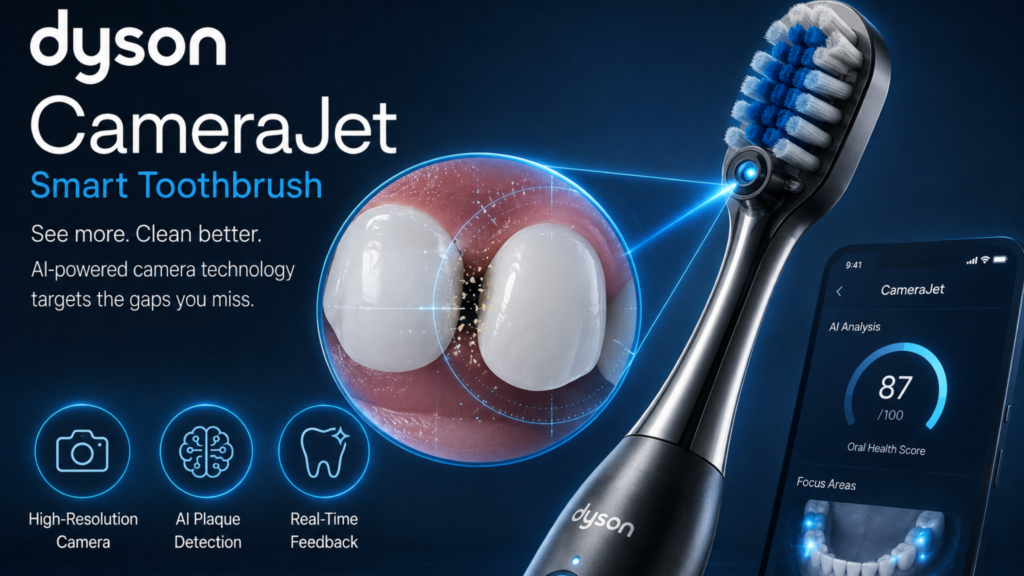
Dyson has entered the electric toothbrush market with the Dyson CameraJet, a $499.99 toothbrush that combines a camera, machine learning and a targeted liquid jet to clean between teeth. The company says it is designed to identify interdental gaps in real time and deliver a burst of mouthrinse directly into them while brushing.
The Dyson CameraJet launched September 1, 2026, as part of Dyson’s new dental system, which also includes a charging dock, travel case, toothpaste and mouthrinse.
What is the Dyson CameraJet?
The CameraJet is not simply a premium electric toothbrush with a smartphone app. Its defining feature is a small 100,000-pixel macro camera built into the brush.
Dyson’s machine-learning system, called Gap Optical Targeting, analyzes live images to identify spaces between teeth. The company says the camera processes 28 images per second and can detect and target a gap within about 100 milliseconds.
When a gap is detected, the toothbrush can automatically fire a narrow burst of liquid into the space.
How does the camera and jet work?
The CameraJet combines three technologies:
- Camera: Provides a close-up view of the teeth and interdental spaces.
- AI and machine learning: Identifies, tracks and predicts gaps between teeth.
- Precision jet: Sends mouthrinse into a targeted gap to help remove plaque.
Dyson says the system uses 16 million lines of code and a machine-learning model trained using 470,000 dental images collected during development.
The jet itself is designed as a conical stream. Dyson says it can deliver up to 0.15 ml of liquid between teeth and activate in as little as one-tenth of a second.
What does the Dyson toothbrush cost?
The Dyson CameraJet costs $499.99 in the U.S.
That puts it well above conventional electric toothbrushes, making it a premium product aimed at consumers interested in technology-driven oral care.
The package is part of a broader Dyson Dental System, rather than just a standalone brush. The launch system includes:
- Dyson CameraJet toothbrush
- Charging dock
- Travel case
- Dyson toothpaste
- Dyson mouthrinse
Dyson launched the system in Ceramic Ultra Blue and Ceramic Pink.
What can the Dyson CameraJet actually do?
Beyond automated jetting, the toothbrush connects to the MyDyson app through Wi-Fi and Bluetooth.
The app provides features including:
- Live viewing through the toothbrush camera
- Guided brushing
- Coverage mapping
- Brushing and flossing insights
- Personalized technique feedback
- Cleaning guidance
Users can also switch between automatic and manual jetting modes and adjust brushing intensity.
The live-view feature essentially lets users see what the camera sees while cleaning, giving the product a very different approach from traditional electric toothbrushes.
Does the Dyson toothbrush record images?
This is an important distinction for a toothbrush equipped with a camera.
Dyson says the CameraJet’s camera is active only during live viewing or automatic jetting. The company says images are not recorded or stored on the toothbrush or in the cloud.
That means the camera is intended to operate as a real-time detection system rather than as a device that builds a video archive of the user’s mouth.
Is the Dyson CameraJet replacing floss?
Not necessarily.
Dyson markets the jet as precision-flossing, but conventional interdental cleaning remains an important part of oral hygiene. The company’s own dental guidance recommends brushing twice daily and cleaning between the teeth at least once a day.
The CameraJet’s selling point is that it attempts to automate part of that process by detecting gaps and directing liquid toward them.
Consumers should therefore view it as a technologically advanced oral-care device rather than assume that owning the toothbrush eliminates the need for professional dental care or other forms of interdental cleaning.
Why is Dyson making a toothbrush?
The move fits Dyson’s broader strategy of applying engineering and sensing technology to everyday personal-care products.
The company says development of CameraJet took six years, involving work in imaging, machine learning and fluid dynamics. Dyson also worked with the National University of Singapore’s Faculty of Dentistry to develop a proxy for plaque that could be used to test the jet system.
That makes the product an interesting example of how consumer electronics companies are increasingly adding cameras, sensors and AI to products that previously required little technology beyond a motor.
Is the $499 Dyson toothbrush worth it?
The answer depends largely on what you want from an electric toothbrush.
Potential advantages:
- Real-time camera-based gap detection
- Automatic targeted liquid jetting
- Detailed app-based brushing feedback
- Live viewing
- Advanced cleaning technology in a single device
Potential drawbacks:
- $499.99 is a very high price for a toothbrush
- Some features depend on the MyDyson app and internet connectivity
- Replacement brush heads and accessories add ongoing costs
- Its benefits may not justify the price for people already maintaining good oral hygiene with conventional brushing and interdental cleaning
The technology is certainly unusual, but whether it represents a meaningful improvement for individual users is a separate question from how sophisticated the engineering is.
The bottom line
The Dyson toothbrush is real, and it is far more ambitious than a conventional electric toothbrush. The $499.99 CameraJet uses a built-in camera and machine learning to identify gaps between teeth and trigger targeted liquid jets while the user brushes.
Its biggest appeal is the combination of AI, imaging and automated interdental cleaning. Its biggest barrier is equally obvious: the price.
For people who want the latest technology in their daily routines, the CameraJet is one of the most unusual consumer products Dyson has introduced. For everyone else, the question will be whether its automated approach offers enough practical benefit to justify a $500 toothbrush.