
Great Smoky Mountains National Park: What to Know Before You Visit
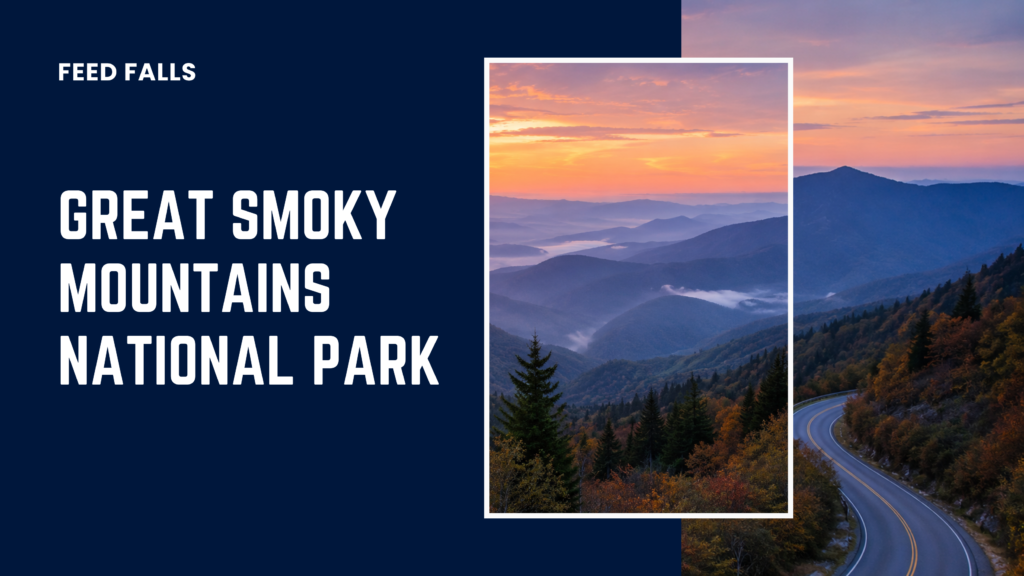
Great Smoky Mountains National Park spans 522,427 acres across Tennessee and North Carolina, making it one of the largest protected mountain landscapes in the eastern United States. It is also the most visited U.S. national park, recording 11.5 million recreation visits in 2025.
But the park is more than scenic mountain roads and hiking trails. Its appeal comes from the combination of Appalachian landscapes, remarkable biodiversity, Cherokee and settler history, historic buildings, wildlife and changing mountain weather.
Where Is Great Smoky Mountains National Park?
The park straddles the border between Tennessee and North Carolina. Popular gateways include Gatlinburg and Townsend on the Tennessee side and Cherokee on the North Carolina side.
The park is divided almost evenly between the two states and contains a wide range of elevations, forests, streams and mountain valleys.
For first-time visitors, some of the best-known areas include:
- Cades Cove — a scenic mountain valley with an 11-mile, one-way loop road.
- Kuwohi and Newfound Gap — high-elevation areas along the Tennessee–North Carolina border.
- Oconaluftee — a major North Carolina gateway near Cherokee.
- Elkmont — known for mountain streams, forests and historic structures.
- Cataloochee — a quieter valley with elk and historic sites.
- Deep Creek — known for streams and waterfalls.
Why Are the Mountains Called the “Smokies”?
The distinctive blue haze that appears around the mountains isn’t smoke from fires.
The Cherokee name for the region, Shaconage, is associated with the idea of a “place of blue smoke.” The haze results from moisture released by vegetation and evaporation, which creates the atmospheric effect seen across the mountains.
That haze is one of the defining visual characteristics of the Smokies and is particularly noticeable when looking across distant ridges.
A Park With a Long Human History
The landscape was inhabited long before the national park existed.
The Cherokee lived throughout the region, developing communities, agricultural practices and extensive trail networks. Their history is an essential part of understanding the Smokies rather than simply a chapter that preceded the park’s creation.
The region later saw European-American settlement, farming and logging. When the national park was being created, land acquisition involved hundreds of small landowners as well as major timber and paper companies. Many families ultimately had to leave homes within the area that became the park.
Congress authorized the park in 1926, and Great Smoky Mountains National Park was officially established in 1934. President Franklin D. Roosevelt formally dedicated it in 1940.
Today, more than 90 historic structures remain within the park, including homes, barns, churches and other buildings that help preserve the area’s Appalachian history.
Why Is Great Smoky Mountains National Park So Biodiverse?
The Smokies are exceptionally diverse because of their combination of elevation, climate, geology and habitat.
The National Park Service says the park protects more than 100 species of trees, 1,500 flowering plants, more than 200 bird species and about 60 mammal species, among many other organisms.
Researchers continue to document species in the park. A long-running biodiversity project has recorded more than 22,000 species, including species new to science.
The Smokies Are Famous for Salamanders
One of the park’s less obvious attractions is its extraordinary salamander diversity.
Great Smoky Mountains National Park is home to 31 salamander species, including the eastern hellbender, one of the largest salamanders in North America.
For visitors, this is another reminder that some of the park’s most interesting wildlife isn’t necessarily the easiest to spot. Wet forests, streams and leaf litter support a remarkable range of smaller species.
Wildlife You Can See
Black bears are among the animals most closely associated with the Smokies. The park is known for its large black bear population, but visitors should treat bears as wild animals and maintain appropriate distances.
Elk are another notable sight, particularly around Cataloochee. The National Park Service reintroduced elk to the region in 2001 after an absence of roughly 150 years.
Other wildlife includes:
- White-tailed deer
- Wild turkeys
- River otters
- Numerous bird species
- Salamanders and other amphibians
Wildlife sightings are never guaranteed, and visitors should avoid approaching or feeding animals.
The Best-Known Mountain: Kuwohi
At 6,643 feet, Kuwohi is the highest point in Great Smoky Mountains National Park. The mountain was formerly known as Clingmans Dome and is also the highest point along the Appalachian Trail.
Its observation tower provides sweeping views across the surrounding Appalachian Mountains when weather conditions allow.
Because elevation changes rapidly in the Smokies, conditions at high elevations can differ considerably from those in nearby valleys.
What Can You Do in the Park?
The Smokies offer considerably more than hiking.
Visitors can:
- Hike mountain trails
- Drive scenic roads
- Explore historic structures
- Watch wildlife
- Visit waterfalls and mountain streams
- Fish in park waters
- Camp
- Photograph wildflowers and landscapes
- Explore Cades Cove and other valleys
- Experience seasonal firefly displays
The park has nearly 850 miles of hiking trails and thousands of miles of streams, giving visitors many ways to explore beyond the busiest viewpoints.
When Should You Visit?
The best time depends on what you want to see.
Spring is particularly attractive for wildflowers and waterfalls, while summer offers long days for hiking and outdoor activities. Fall brings colorful foliage and is one of the busiest periods in the park. Winter can provide a quieter experience, although higher elevations may have significantly different weather.
Visitors planning a trip should check current conditions, road closures and seasonal restrictions before traveling.
One important practical detail: vehicles parked in the park for more than 15 minutes require a valid parking tag.
Why Is Great Smoky Mountains National Park So Popular?
The park’s popularity is partly geographical. The National Park Service notes that it is within a day’s drive of more than 60% of the U.S. population. It is also connected to major regional attractions and the Appalachian Trail.
That accessibility, combined with free admission to the park itself, scenic drives and a huge variety of outdoor activities, helps explain its enormous visitor numbers.
In 2025, Great Smoky Mountains National Park recorded 11,527,939 recreation visits, more than twice the number recorded by the second-most visited national park, Zion.
The Bottom Line
Great Smoky Mountains National Park combines mountain scenery, biodiversity and human history on a scale that few U.S. parks can match. Its 522,427 acres stretch across two states and include everything from high Appalachian peaks and waterfalls to historic communities and exceptionally diverse wildlife.
Its popularity means some areas can become crowded, particularly during peak seasons. For a better experience, travelers should look beyond the most famous viewpoints and explore the park’s quieter valleys, trails and historic areas.