
Rich Dad Poor Dad Author in Debt: Why Robert Kiyosaki Owes $1.2 Billion
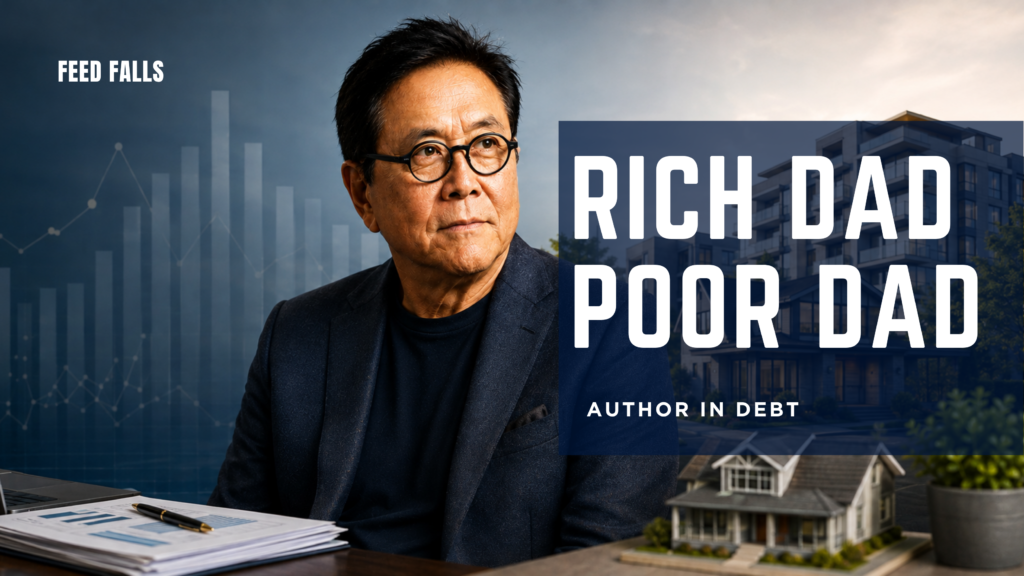
Robert Kiyosaki, the author of Rich Dad Poor Dad, has publicly said he is carrying about $1.2 billion in debt. That sounds contradictory for someone whose career is built around teaching people how to build wealth, but Kiyosaki says the debt is largely connected to his investment strategy rather than ordinary consumer borrowing.
The important distinction is that Kiyosaki’s $1.2 billion figure is a self-reported amount, not a publicly audited personal balance sheet. Recent reports continue to cite him describing himself as roughly $1.2 billion in debt, while he argues that he uses borrowed money to acquire assets rather than to fund a lifestyle.
So, is the Rich Dad Poor Dad author actually in debt? Yes, according to Kiyosaki’s own repeated statements. But that does not mean he is $1.2 billion personally underwater or facing imminent bankruptcy.
Who Is the Rich Dad Poor Dad Author?
Robert Kiyosaki is an entrepreneur, investor and personal-finance author best known for Rich Dad Poor Dad, originally published in 1997.
The book became one of the best-known personal-finance titles in the world and established Kiyosaki’s central philosophy: financially successful people should focus on acquiring assets, developing financial education and using money strategically rather than relying solely on employment income.
Kiyosaki’s own website describes him as an entrepreneur, educator and investor and says his financial philosophy was shaped by the contrasting lessons of his biological father and his childhood friend’s father, whom he calls his “Rich Dad.”
That background is important because his unusual attitude toward debt is not a recent development. Using debt as leverage has been a central part of his investment philosophy for decades.
How Much Debt Does Robert Kiyosaki Have?
The figure most frequently associated with Kiyosaki is $1.2 billion.
He has stated this amount publicly on multiple occasions. In a 2023 interview, for example, Kiyosaki said he was not $600 million in debt but approximately $1.2 billion in debt.
The figure was widely reported again in January 2024 after Kiyosaki discussed his debt in an Instagram video and on the Disruptors podcast. He explained that he had used debt to acquire assets and argued that borrowing can be productive when it is used to purchase investments capable of generating income or appreciating in value.
More recently, reports from 2025 and 2026 continued to quote Kiyosaki putting his debt at around $1.2 billion.
However, there is an important qualification:
There is no independently audited public document establishing that Kiyosaki personally owes exactly $1.2 billion.
The figure comes primarily from Kiyosaki himself and reporting based on his interviews and social-media statements. That distinction matters when discussing someone’s personal finances.
Why Would Someone With $1.2 Billion in Debt Not Be Bankrupt?
This is where Kiyosaki’s philosophy becomes easier to understand.
Debt itself does not tell you whether someone is financially healthy.
Consider two hypothetical borrowers:
Person A
- Borrows $500,000 to buy an investment property.
- The property generates rental income.
- The property’s value may rise over time.
- The rent helps service the debt.
Person B
- Borrows $500,000 for cars, vacations and consumer purchases.
- Those purchases produce no income.
- The borrower still has to make the payments.
Both people owe $500,000, but their financial positions are very different.
Kiyosaki calls the first approach good debt and the second bad debt. His official Rich Dad material repeatedly makes the same distinction, arguing that debt can be useful when it helps acquire income-producing assets.
That does not mean investment debt is automatically safe. It simply explains why a large debt balance does not necessarily equal financial insolvency.
What Does Kiyosaki Say His Debt Is Used For?
Kiyosaki has repeatedly said that he uses borrowed money to acquire assets, particularly real estate.
His basic argument is:
Borrow money → acquire an asset → generate income or build equity → use the asset’s economics to support the debt.
This is essentially the concept of financial leverage.
Real estate investors commonly use mortgages for this purpose. Instead of paying the entire purchase price in cash, an investor contributes some capital and borrows the remainder.
If the investment performs well, leverage can amplify returns on the investor’s own capital.
But the opposite is also true.
If property values fall, rental income declines or interest costs rise, leverage can amplify losses.
That’s the part of Kiyosaki’s philosophy that is often lost when his “$1.2 billion debt” statement is repeated online.
Kiyosaki’s View: Debt Is Not the Same as Poverty
Kiyosaki’s approach directly challenges the conventional advice that people should simply eliminate all debt.
His argument is that the purpose and economics of the debt matter more than the headline balance.
He distinguishes between borrowing to acquire something that generates cash flow and borrowing to purchase something that consumes cash.
For example:
| Type of borrowing | Potential purpose | General characteristic |
| Mortgage on rental property | Acquire income-producing property | Can potentially generate cash flow |
| Business loan | Expand a profitable business | Depends on business performance |
| Credit-card balance | Fund everyday consumption | Usually expensive and non-income-producing |
| Auto loan for personal vehicle | Purchase transportation | Generally a consumption expense |
| Loan for speculative investment | Bet on future price appreciation | Can carry substantial risk |
This framework is central to Kiyosaki’s teachings, but it should not be interpreted as a blanket endorsement of borrowing.
Debt only works as leverage when the underlying asset or business can support the financial obligation.
Kiyosaki Has Actually Experienced Serious Financial Trouble Before
The $1.2 billion figure isn’t the first time Kiyosaki’s finances have attracted attention.
His business history includes failed ventures and significant financial difficulties.
According to Rich Dad’s own biography, one of Kiyosaki’s early businesses selling wallets experienced problems that nearly pushed him into bankruptcy.
Rich Dad also says that Robert and Kim Kiyosaki were once nearly $1 million in debt after marrying and moving to California. The company describes that period as part of the experience that shaped Kiyosaki’s views about debt and entrepreneurship.
So the idea that Kiyosaki has never experienced financial distress would be incorrect.
He has.
But his later strategy involved using debt differently from the consumer debt that caused problems earlier in his career.
Did Robert Kiyosaki Ever File for Bankruptcy?
There is another important piece of the story.
In 2012, Rich Global LLC, a company associated with Kiyosaki’s business empire, filed for Chapter 7 bankruptcy.
This followed a legal dispute with Learning Annex. A federal court had entered a judgment of approximately $23.7 million against Rich Global, and the company subsequently filed for bankruptcy protection in August 2012.
That bankruptcy involved Rich Global LLC, not a court finding that Robert Kiyosaki personally filed for bankruptcy.
This distinction is frequently blurred in online discussions.
The bankruptcy court record identifies Rich Global LLC as the debtor in the Chapter 7 case.
Therefore, saying “Robert Kiyosaki personally filed bankruptcy over $1.2 billion of debt” would be misleading.
Does $1.2 Billion in Debt Mean Kiyosaki Is Poor?
No.
Debt and net worth are two different things.
Someone could theoretically have:
- $1.2 billion in assets
- $1.2 billion in liabilities
- $0 net worth
Or:
- $2 billion in assets
- $1.2 billion in liabilities
- $800 million in net assets
The debt number alone doesn’t tell us which situation applies to Kiyosaki.
And because there is no independently verified, current public balance sheet for Kiyosaki’s complete personal finances, it is difficult to calculate his actual net worth from the $1.2 billion figure alone.
This is one reason headlines suggesting that Kiyosaki is simply “$1.2 billion underwater” go further than the available evidence supports.
Why Kiyosaki Isn’t Worried About the Debt
Kiyosaki’s explanation is essentially that his lenders are financing assets rather than his personal consumption.
He has argued that if he borrows heavily to acquire assets, the debt is secured against those assets and the investment economics can potentially support the borrowing.
He has also made deliberately provocative comments about what would happen if he became unable to repay his obligations, saying that if he went bankrupt, the banks would have problems too. His comments were widely reported after his 2023 Instagram video.
That statement should not be interpreted as a universal financial principle.
Banks don’t simply lose money whenever a borrower defaults. Depending on the structure of the loan and collateral, lenders can seize assets, restructure debt or pursue other remedies. The consequences depend on the contracts, guarantees, collateral and applicable law.
The Biggest Risk With Kiyosaki’s Debt Strategy
The concept of using debt to acquire assets is legitimate. The risk is leverage.
Suppose an investor buys a $1 million property using:
- $200,000 of their own money
- $800,000 of borrowed money
If the property rises to $1.2 million, the investor has gained $200,000 in property value before costs and financing expenses.
But if the property falls to $800,000, the investor’s equity can be wiped out even though the property still exists.
The debt doesn’t disappear when the asset falls.
This is why professional investors pay close attention to:
- Interest rates
- Debt-service coverage
- Loan-to-value ratios
- Cash flow
- Vacancy rates
- Refinancing risk
- Asset liquidity
- Personal guarantees
Kiyosaki’s philosophy emphasizes financial education, but leverage requires risk management as much as financial confidence.
So, Is the Rich Dad Poor Dad Author Actually in Debt?
Yes, according to Robert Kiyosaki’s own statements, he has around $1.2 billion in debt.
But there are several important qualifications.
Confirmed
- Robert Kiyosaki is the author of Rich Dad Poor Dad.
- He has publicly stated that he carries approximately $1.2 billion in debt.
- He says much of his borrowing is connected to acquiring assets.
- He advocates distinguishing productive debt from consumer debt.
- A company associated with his business empire, Rich Global LLC, filed Chapter 7 bankruptcy in 2012.
Not established by the $1.2 billion claim alone
- That Kiyosaki personally owes exactly $1.2 billion under all circumstances.
- That he is insolvent.
- That his assets are worth less than his liabilities.
- That he personally filed the 2012 Rich Global bankruptcy.
- That his debt strategy would be appropriate for ordinary investors.
Those distinctions are essential when evaluating the story.
What Can Investors Actually Learn From Kiyosaki’s Debt?
The most useful lesson isn’t “take on billions of dollars of debt.”
It’s understanding why the debt exists.
Borrowing can potentially help build wealth when it finances productive assets and the borrower has enough cash flow and financial reserves to withstand setbacks.
But leverage can also magnify losses.
For most households, expensive consumer debt—particularly revolving credit-card balances—is very different from carefully structured investment financing.
Kiyosaki’s own financial history illustrates both sides of the equation: he experienced severe financial difficulties early in his career, later built a philosophy around using debt as leverage, and now publicly describes himself as carrying roughly $1.2 billion in debt.
That makes his story interesting, but it doesn’t make his strategy universally safe.
Bottom Line
The Rich Dad Poor Dad author is in debt, at least according to his own repeated public statements. Robert Kiyosaki has put the figure at approximately $1.2 billion, and he says the borrowing is primarily part of a strategy of acquiring assets rather than financing an expensive lifestyle.
However, the $1.2 billion figure should not be confused with $1.2 billion of personal losses or proof that Kiyosaki is bankrupt.
The more revealing question is not “How much does Robert Kiyosaki owe?” but “What assets support that debt, what income do they generate, and what happens if those assets decline in value?”
Without a complete, independently verified balance sheet, outsiders cannot answer those questions with certainty.
And that is ultimately the important lesson: debt can be a tool, but the size, cost, collateral and cash flow behind the debt determine whether leverage is helping or hurting.