
Jim Farley Ford Quality Control: Has Ford Finally Fixed Its Quality Problems?
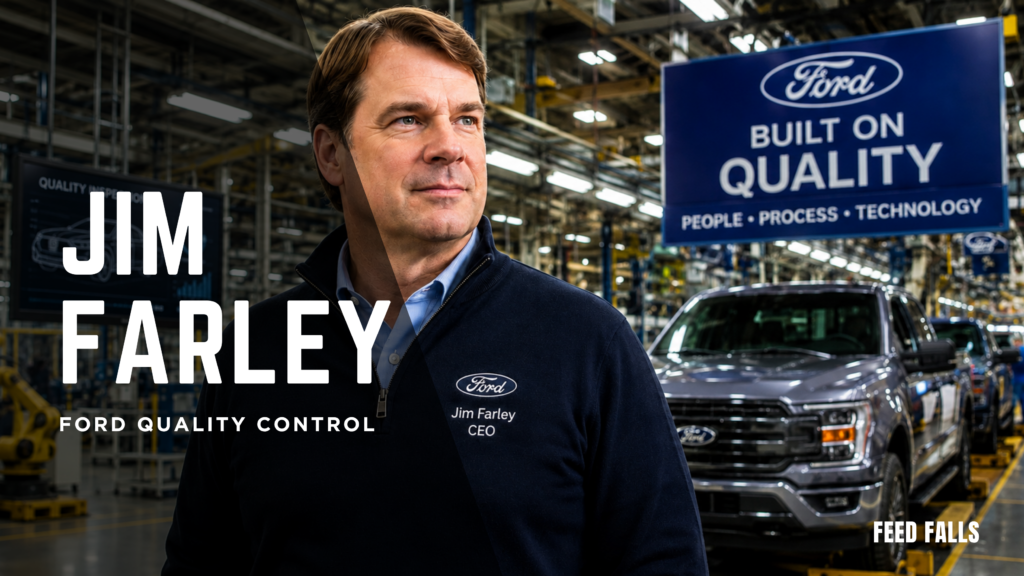
Ford CEO Jim Farley has spent much of his tenure trying to change how the automaker approaches quality control. After years of high warranty costs, manufacturing problems and recalls, Ford has overhauled parts of its engineering, manufacturing, testing and supplier processes.
The results are beginning to show. In June 2026, Ford ranked No. 1 among mainstream brands in J.D. Power’s U.S. Initial Quality Study, recording 152 problems per 100 vehicles. That was a major improvement from Ford’s 2023 position, when it ranked 15th among mainstream brands.
But the story is more complicated than one ranking. Initial quality measures problems during the first 90 days of ownership, while recalls and long-term dependability can reveal problems that appear much later. Ford’s quality-control turnaround is therefore best understood as an ongoing process rather than a finished success story.
Why Jim Farley Made Ford Quality a Priority
When Farley became Ford CEO in October 2020, quality problems were already creating significant financial and operational pressure.
In 2024, Farley acknowledged that Ford’s engineering, supply-chain and manufacturing capabilities had deteriorated more than he had realized. He also said Ford incurred about $1.9 billion in excess warranty costs in 2023.
The problem was not simply the number of recalls. Farley argued that Ford needed to change the way it developed, manufactured and launched vehicles.
That meant making quality a responsibility shared across:
- Engineering
- Manufacturing
- Purchasing and suppliers
- Plant management
- Vehicle testing
- Product launches
- Warranty and customer feedback
The goal was to catch defects before vehicles reached customers, rather than discovering problems after production and then dealing with expensive repairs, recalls and warranty claims.
What Changed Under Farley’s Quality-Control Strategy?
Ford’s approach has evolved over several years rather than through one single initiative.
1. More Testing Before Vehicles Launch
One of Farley’s most visible changes was increasing testing and validation before new vehicles reached dealerships.
The redesigned Super Duty pickup became an important example. Ford slowed the launch to conduct additional testing and problem-solving, a decision Farley said cost the company roughly $1 billion in foregone EBIT. He described it as the right trade-off for customers and the company.
Ford also increased real-world testing and additional inspections at assembly plants.
The philosophy is relatively straightforward: spending money before a vehicle reaches customers can be preferable to spending considerably more fixing problems afterward.
2. More Intensive Factory Checks
Ford has also increased quality checks on the production line.
Earlier in Farley’s tenure, the company introduced additional assembly-plant inspections and changed how vehicles were signed off before launch.
For the Super Duty program, Ford used additional line inspections and even conducted daily pre-delivery road testing on selected trucks.
These measures are designed to identify problems that conventional end-of-line inspections may miss.
3. Greater Use of Data and Software
Modern vehicles contain increasingly complex software, electronics and connected systems. That creates a different type of quality-control problem from traditional mechanical defects.
Ford has responded by expanding software validation and using over-the-air updates to address some issues before they become warranty problems. The company also says it has increased testing of critical systems such as powertrains, steering and braking.
This is increasingly important because vehicle quality is no longer determined only by engines, transmissions, paint and panel fit.
A vehicle can be mechanically sound while still frustrating owners because of:
- Infotainment glitches
- Smartphone connectivity problems
- Software errors
- Driver-assistance issues
- Faulty displays
- Electronic controls
J.D. Power’s 2026 study illustrates the challenge: infotainment was the only major category in which reported problems increased industrywide, with Apple CarPlay and Android Auto connectivity contributing significantly to complaints.
Ford’s Quality Numbers Have Improved Dramatically
The clearest evidence that Ford’s efforts are producing results comes from J.D. Power.
In the 2026 U.S. Initial Quality Study, Ford recorded 152 problems per 100 vehicles, the best score among mainstream brands.
Nissan followed with 156 PP100, while Buick recorded 162 PP100.
Ford’s improvement is particularly notable when compared with its recent history.
| Year | Ford’s Initial Quality Position |
| 2023 | 15th among mainstream brands |
| 2026 | 1st among mainstream brands |
Ford also had three models rank highest in their respective segments in the 2026 study: the F-150, Mustang and Super Duty.
The industry itself improved substantially in 2026. J.D. Power reported 175 problems per 100 vehicles across the industry, down from 192 the previous year.
So Ford’s result is significant, but it should not be interpreted as proof that every Ford vehicle is now trouble-free.
Initial Quality Is Not the Same as Long-Term Reliability
This distinction is important when evaluating Jim Farley’s Ford quality-control efforts.
J.D. Power’s Initial Quality Study measures problems experienced during the first 90 days of ownership. It is useful for evaluating new-vehicle launch quality, but it does not tell the entire story of ownership.
Long-term dependability can look different.
J.D. Power’s 2026 Vehicle Dependability Study, which examines vehicles after three years of ownership, found an industry average of 204 problems per 100 vehicles. Buick ranked highest among mass-market brands, while Lexus led the overall rankings.
That doesn’t invalidate Ford’s IQS achievement. It simply means initial quality and long-term dependability are different measurements.
A vehicle can have a strong launch while still developing problems years later.
Ford Still Has a Recall Problem
This is another reason to be cautious about declaring Ford’s quality turnaround complete.
Ford’s improved initial-quality score exists alongside a substantial recall history.
NHTSA’s 2025 annual recall data shows Ford had 56 recalls covering more than 6 million recalled vehicles in the dataset used for its recall-completion analysis. Individual recalls had widely varying completion rates, demonstrating that recall volume and recall resolution are separate issues.
NHTSA’s 2025 annual recalls report also listed several Ford recalls among campaigns that, as of February 2026, had gone more than 60 days without an available remedy.
This creates an important distinction:
Ford may be getting better at preventing problems in newer vehicles while still dealing with quality issues from older vehicles.
That is why recall totals alone cannot determine whether Farley’s quality strategy is working—but neither can a single J.D. Power award.
Farley’s Quality-Control Philosophy Is About Preventing Problems
The bigger change at Ford is organizational.
Farley has argued that quality cannot simply be the responsibility of a dedicated quality department. Engineering, purchasing, suppliers and factory management all influence the final product.
That means Ford has increasingly focused on finding the root cause of defects instead of treating each customer complaint as an isolated incident.
The approach includes:
- Finding problems earlier.
- Identifying their underlying causes.
- Correcting the manufacturing or engineering process.
- Applying the lesson across other vehicles or plants.
- Measuring whether the change actually improves quality.
Ford says it has also more than doubled its team of safety and technical experts over a two-year period and increased destructive and failure testing of critical vehicle systems.
Why Farley Says the Job Isn’t Finished
Ford’s No. 1 mainstream-brand ranking is a major improvement, but Farley has not treated it as the end of the quality campaign.
That caution makes sense.
J.D. Power’s IQS captures only the early ownership experience, while Ford continues to manage recalls and older quality problems. At the same time, the automotive industry is becoming more software-dependent, creating new categories of defects that traditional manufacturing quality systems were not designed to handle.
Farley has reportedly described Ford’s recent quality improvement as something that still needs to prove it is sustainable.
That may ultimately be the most important test.
A temporary improvement in rankings is useful. A quality culture that consistently prevents defects across multiple vehicle generations is much more valuable.
So, Has Jim Farley Fixed Ford’s Quality-Control Problems?
Not completely—but Ford’s recent progress is substantial.
The evidence points to a genuine improvement in new-vehicle quality:
- Ford went from 15th among mainstream brands in the 2023 J.D. Power IQS to No. 1 in 2026.
- Ford recorded 152 problems per 100 vehicles in the 2026 study.
- F-150, Mustang and Super Duty each topped their respective segments.
- Ford has expanded testing, inspections, software validation and quality personnel.
- Yet substantial recalls and long-term dependability concerns remain part of the picture.
The fairest conclusion is that Jim Farley’s Ford quality-control strategy appears to be producing measurable improvements, particularly in new-vehicle launch and initial quality. Whether Ford can sustain those gains over several years—and translate them into stronger long-term reliability—will determine whether this is a lasting transformation or simply another cycle in the company’s long history of quality improvements and setbacks.
Key Takeaway
Jim Farley’s approach to Ford quality control goes beyond adding more inspections at the end of the assembly line. Ford has been trying to change how it designs, tests, builds and launches vehicles, with greater accountability across engineering, suppliers and manufacturing.
The 2026 J.D. Power result suggests that those changes are having a real effect on initial quality. But recalls and long-term dependability show why the turnaround should still be viewed as a work in progress.
For consumers, the practical lesson is simple: Ford’s recent quality numbers are encouraging, but a J.D. Power initial-quality ranking should be considered alongside model-specific reliability data, recall history and long-term ownership evidence before buying a vehicle.