
Old Farmer Almanac Winter Forecast 2026–27: Snow and Cold
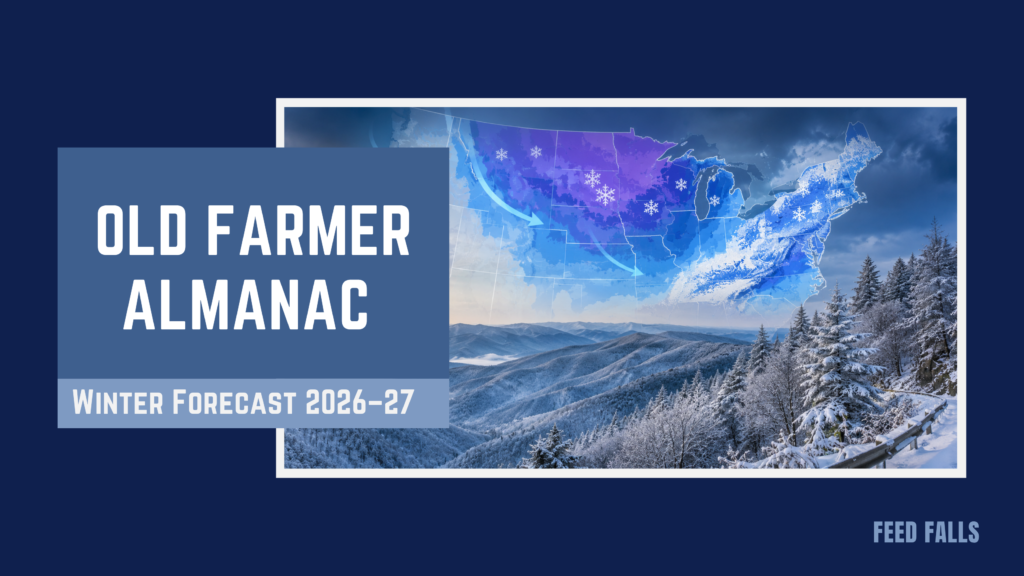
The Old Farmer’s Almanac winter forecast for 2026–27 calls for a mostly mild winter across much of the United States, but with several notable exceptions. The Almanac expects colder conditions across parts of the Northeast, Appalachians and Ohio Valley, while above-normal snowfall is forecast for parts of the Northeast, Appalachians, Intermountain region, Pacific Northwest and Alaska.
The forecast was published August 27, 2026. It is a long-range prediction, so it should be treated as an outlook rather than a day-to-day weather forecast.
Where Will the Winter Be Coldest?
The Old Farmer’s Almanac expects much of the country to experience near-normal or warmer-than-normal temperatures.
The main colder zone stretches from central New England south through the Appalachians and into the Ohio Valley. Hawaii is also expected to have below-normal temperatures.
The Almanac identifies early and mid-January as particularly cold periods in parts of the Northeast. In the Ohio Valley and Appalachian region, colder conditions are expected to extend into February.
Other parts of the country are expected to have a generally milder winter, although a mild seasonal average does not rule out individual freezes or cold snaps.
Where Is the Old Farmer’s Almanac Forecasting More Snow?
The forecast identifies several regions that could see above-normal snowfall:
- Central New England through the Appalachians
- Parts of the southern Northeast
- Intermountain West
- Pacific Northwest
- Alaska
The southern part of the Northeast is expected to have its snowiest stretches around mid- and late December, mid-January, and early and late March. Higher elevations in the northern Appalachians could see significant snow during January and February.
For the Intermountain region, the Almanac highlights late November, late December and early February. The Pacific Northwest could see heavier snow episodes around late December, mid-January and mid-February.
What Does the Forecast Say for Skiers?
The outlook is particularly interesting for parts of the Mid-Atlantic and southern Appalachians.
The Almanac categorizes areas including New York, Pennsylvania, West Virginia, Virginia and North Carolina as having a potentially cold and snowy winter. That could create favorable conditions for ski resorts in those areas if the forecast verifies.
Northern Vermont, New Hampshire and Maine have a different outlook. The Almanac expects a milder and drier winter there, which contrasts with the colder and snowier conditions predicted farther south.
That regional split is important: a forecast for a snowy winter in the Appalachians does not automatically mean the entire Northeast will have above-average snowfall.
How Does El Niño Factor Into the Forecast?
One reason the 2026–27 winter outlook is attracting attention is the return of El Niño.
The Old Farmer’s Almanac says a strong El Niño is expected to continue through winter and could influence the position of the jet stream and the distribution of cold air, rain and snow.
This part of the forecast is supported by an independent source of climate information. NOAA’s Climate Prediction Center said in August that El Niño was strengthening and gave greater than a 90% chance of a very strong event during the Northern Hemisphere fall and winter.
That does not mean El Niño guarantees a particular weather pattern in a specific city. Regional weather depends on several interacting atmospheric and oceanic factors.
How Reliable Is the Old Farmer’s Almanac Winter Forecast?
This is the part readers should keep in mind before making travel or weather decisions based on the Almanac.
The Old Farmer’s Almanac uses its own long-range forecasting methodology, which it describes as combining solar science, climatology, meteorology, historical weather patterns, solar activity, climate data and large-scale climate signals.
However, a seasonal outlook is fundamentally different from a forecast for a particular storm or week.
Even POWDER, while highlighting the potentially favorable conditions for East Coast skiing, notes that long-range winter forecasts are rarely accurate and that forecasts should be monitored as winter approaches.
For practical decisions—such as whether a snowstorm will affect a trip—shorter-range forecasts from the National Weather Service are much more useful.
What the 2026–27 Forecast Means by Region
| Region | Old Farmer’s Almanac outlook |
| Southern Northeast | Colder and snowier than normal |
| Central New England | Colder periods; snow varies by area |
| Appalachians | Colder with above-normal snowfall in many areas |
| Ohio Valley | Notable cold spells |
| Intermountain West | Above-normal snowfall |
| Pacific Northwest | Above-normal snowfall |
| Alaska | Above-normal snowfall |
| Upper Midwest | Generally milder, but significant cold snaps possible |
| Deep South | Generally milder |
| Desert Southwest | Generally milder |
| Hawaii | Below-normal temperatures |
The forecast varies considerably within some of these broad regions, so travelers should check the Almanac’s location-specific forecast rather than relying solely on a national summary.
What Travelers Should Take From the Forecast
For winter travelers, the forecast is best viewed as an early planning signal.
If you’re considering a ski trip to the southern Appalachians or Mid-Atlantic, the outlook suggests keeping those destinations on the radar. Conversely, travelers heading to northern New England should not assume that a generally snowy Northeast forecast means every resort will receive above-average snowfall.
Most importantly, conditions can change significantly before winter arrives.
The Old Farmer’s Almanac winter forecast points toward a highly variable 2026–27 season, with a mild overall pattern interrupted by colder and snowier pockets. The return of a potentially strong El Niño provides a genuine climate signal behind some of those regional expectations, but it does not make the Almanac’s specific snowfall predictions certain.
For travel planning, use this forecast to identify regions worth watching, then rely on updated official forecasts as your trip gets closer.