
Warren Buffett’s Guidance for a Stock Market Downturn
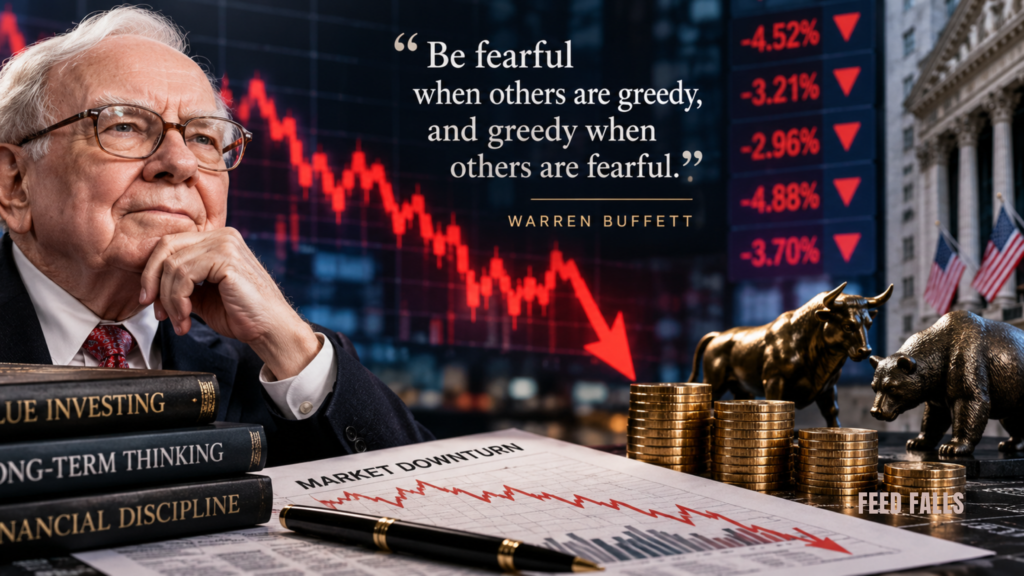
Warren Buffett’s guidance for a stock market downturn comes down to three rules: never invest with borrowed money, don’t sell in a panic, and treat big drops as a chance to buy more. He has repeated those ideas for decades, through crashes far worse than anything most investors have seen.
That advice matters right now because the market is expensive and nervous at the same time. The S&P 500 set its first record high since mid-August on October 6, while analysts warn about an AI bubble. One analyst cited by Benzinga said the index could fall more than 35%, to 5,000, by 2027 if the AI boom turns down. Nobody knows whether that happens. Buffett’s point is that you don’t need to know.
What is Warren Buffett’s stock market downturn guidance?
His clearest statement came in his 2017 letter to Berkshire Hathaway shareholders. He wrote that there’s simply no telling how far stocks can fall in a short period, and that no one can predict when big declines will happen.
He didn’t treat those drops as disasters. He said major declines offer extraordinary opportunities to people who aren’t weighed down by debt, and he pointed readers to Rudyard Kipling’s 1895 poem “If,” which opens with the idea of keeping your head while everyone around you loses theirs.
The famous short version is older. In an October 2008 New York Times op-ed titled “Buy American. I Am.,” written during the financial crisis, Buffett explained that his buying followed one simple rule: be fearful when others are greedy, and greedy when others are fearful.
Why does Buffett warn against borrowing to buy stocks?
Because a falling market can wipe you out before it recovers. In that same 2017 letter, Buffett listed the four times Berkshire’s own stock got crushed, and he called that table the strongest argument he could make against ever using borrowed money to own stocks. (Business Insider)
Here are three of those drops:
| Period | Berkshire stock decline | What was happening |
|---|---|---|
| March 1973 to January 1975 | 59.1% | Oil crisis and recession; the S&P 500 fell as much as 44% |
| October 1987 | 37.1% | The Black Monday crash |
| September 2008 to March 2009 | 50.7% | The global financial crisis |
Even the most successful investor of his era watched his company’s stock lose more than half its value. If you owe money on a margin loan (cash borrowed from your broker to buy stocks) when that happens, your broker can force you to sell at the bottom. Without debt, you can wait.
What did Buffett do during the 2008 crash?
He bought. In the 2008 op-ed, he wrote that he’d been moving his personal money out of US government bonds and into American stocks, and that his non-Berkshire net worth would soon be all in US stocks if prices stayed attractive. (Honolulu Advertiser / AP)
There’s an honest footnote here that most articles skip. Buffett later said he wished he’d written that op-ed later, because the market kept falling for months after it ran. Even Buffett couldn’t time the bottom. That’s the real lesson: you don’t need perfect timing if you’re buying steadily and holding for years.
What is Berkshire Hathaway doing now?
Berkshire, now run by CEO Greg Abel after Buffett stepped down at the end of 2025, spent years getting cautious. It ended the first quarter of 2026 with a record $397.4 billion in cash and Treasury bills, after 14 straight quarters of selling more stock than it bought. (24/7 Wall St.) Buffett had said the long selling streak was mainly because valuations were too high to find good deals.
That changed this summer. In the second quarter, Berkshire’s cash fell to $365.5 billion and the company became a net buyer of stocks, purchasing nearly $20 billion more than it sold. It also spent about $4.5 billion buying back its own shares.
My read: Berkshire’s huge cash pile isn’t a crash prediction. It’s the “be fearful when others are greedy” half of Buffett’s rule in action. Holding cash means Berkshire can buy aggressively if prices fall, without borrowing or selling anything.
How can you follow Buffett’s advice with a regular paycheck?
Most people can’t hold $365 billion in cash. What you can do is keep investing a fixed amount every month, which is called dollar-cost averaging. When prices drop, the same dollars buy more shares.
Here’s a worked example. Say you invest $500 a month in an S&P 500 index fund, and the fund’s price drops 30% over three months and then fully recovers:
| Month | Fund price | Shares bought with $500 |
|---|---|---|
| 1 | $100 | 5.00 |
| 2 | $85 | 5.88 |
| 3 | $70 | 7.14 |
| 4 | $70 | 7.14 |
| 5 | $85 | 5.88 |
| 6 | $100 | 5.00 |
| Total | 36.05 shares for $3,000 |
When the price gets back to $100, your 36.05 shares are worth about $3,605. That’s a 20% gain, even though the fund only returned to where it started. Your average cost per share was about $83.
If you had panicked and stopped investing in month 2, you’d have missed the cheapest shares. If you’d sold at $70, you’d have locked in the loss. This is a simplified example with made-up prices, but the math is why Buffett says downturns help long-term buyers.
When should you not follow this advice?
Buffett’s guidance assumes your money can sit untouched for years. If you need cash for a home down payment, tuition or retirement withdrawals in the next few years, that money arguably shouldn’t be in stocks at all, crash or no crash.
It also assumes you have a cash cushion. Buffett’s warning about debt applies to your household too. If losing your job would force you to sell investments to pay bills, an emergency fund comes before buying the dip.
What to Watch Next
- Third-quarter earnings season (mid-October to early November 2026): Big tech companies report results in the coming weeks. Analysts see this as a key test of whether AI spending is paying off.
- Berkshire Hathaway third-quarter results (expected early November 2026): Watch whether Berkshire kept buying stocks or went back to building cash.
- US midterm elections (November 3, 2026): Some market researchers have flagged the election result as a possible trigger for volatility in AI stocks.
- Berkshire’s 13F filing (expected mid-November 2026): This quarterly report to the SEC shows exactly which stocks Berkshire bought and sold.
Pingback: Warren Buffett's S&P 500 Advice: The 90/10 Rule Explained - Feed Falls