
Warren Buffett’s S&P 500 Advice: The 90/10 Rule Explained
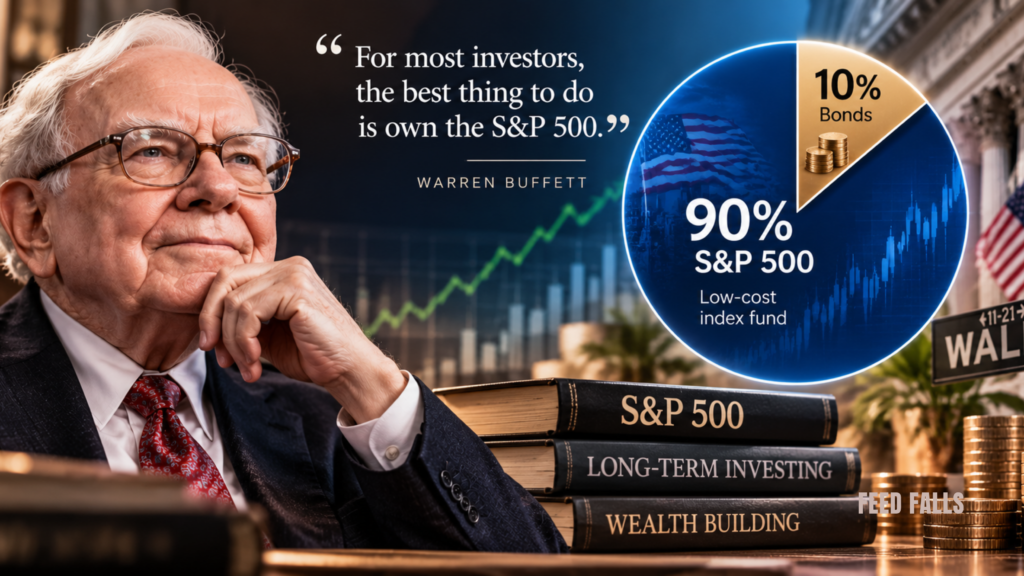
Warren Buffett’s investing advice on the S&P 500 is simple: most people should buy a very low-cost S&P 500 index fund and hold it for decades. For his own family, he went further and laid out a 90/10 rule, with 90% in an S&P 500 index fund and 10% in short-term government bonds.
That advice is getting fresh attention this fall. Buffett has left the CEO job, index funds keep beating most professional stock pickers, and many people are wondering whether to put new money in now, with the market near record highs. Here’s what he actually said and how to use it.
What is Warren Buffett’s investing advice on the S&P 500?
The clearest version comes from his 2013 letter to Berkshire Hathaway shareholders. Describing the instructions in his will, he told the trustee to put 10% of the cash in short-term government bonds and 90% in a very low-cost S&P 500 index fund, and he suggested Vanguard’s.
He has repeated the idea for years. At Berkshire’s 2020 virtual meeting, held during the COVID crash, he said that for most people the best move is to own an S&P 500 index fund.
An index fund is a fund that simply buys every stock in an index, instead of paying a manager to pick winners. The S&P 500 index tracks about 500 of the biggest US companies, so one fund gives you a slice of all of them.
Why does Buffett prefer index funds over stock picking?
Two reasons: costs and the odds. Most professionals who try to beat the S&P 500 fail, especially after fees.
S&P Dow Jones Indices tracks this in its SPIVA scorecard. In 2025, 79% of active large-cap US stock funds underperformed the S&P 500, the fourth-worst result in the scorecard’s 25-year history. (SPIVA U.S. Year-End 2025) This year hasn’t been much better. In the first half of 2026, 67% of active large-cap US funds trailed the index. (Advisor Perspectives)
Buffett also put his own money on the line. He bet that from 2008 through 2017, the S&P 500 would beat a portfolio of hedge funds after all fees, and he backed his side with a Vanguard S&P 500 index fund. The index fund returned 7.1% a year over the decade, while the hedge fund picks averaged just 2.2% after fees. (Long Now Foundation) The winnings went to Girls Inc. of Omaha, which ended up receiving about $2.27 million. (Institutional Investor) warren buffett wins million dollar long bet
How much does a low fee actually save you?
An expense ratio is the yearly fee a fund charges, shown as a percentage of your money. The Vanguard S&P 500 ETF (VOO) charges 0.03%, which works out to $3 a year for every $10,000 invested.
That sounds tiny, and it is. The point is what happens when fees compound for decades. Here’s a worked example: $100,000 invested once, left alone for 30 years, earning 8% a year before fees.
| Annual fee | Value after 30 years | Lost to fees vs. 0.03% |
|---|---|---|
| 0.03% (like VOO) | About $998,000 | None |
| 0.14% | About $968,000 | About $30,000 |
| 1.00% | About $761,000 | About $237,000 |
The returns are a made-up example, not a forecast. But the gap is real math: a 1% fee doesn’t cost you 1% of your money. Over 30 years it costs you nearly a quarter of the final result.
How much could $400 a month grow in an S&P 500 fund?
You’ve probably seen headlines promising that a small monthly amount turns into close to $1 million. Those numbers depend heavily on the return you assume. Here’s what $400 a month (a total of $144,000 over 30 years) becomes at different yearly returns:
| Average annual return | After 10 years | After 20 years | After 30 years |
|---|---|---|---|
| 6% | $65,600 | $184,800 | $401,800 |
| 7% (Buffett’s bet decade) | $69,200 | $208,400 | $488,000 |
| 9.4% (90/10 example below) | $79,200 | $281,100 | $796,300 |
| 10% | $81,900 | $303,700 | $904,200 |
Our calculation assumes monthly deposits and monthly compounding, with no taxes or fees. The jump from 6% to 10% nearly doubles the 30-year total, which is why it pays to be skeptical of any single headline number.
How does the 90/10 rule work with real numbers?
The 90/10 split mixes growth with a small cushion. Short-term government bonds, like Treasury bills, pay steady interest and barely move in price.
If the S&P 500 returned 10% and Treasury bills paid 4%, a 90/10 portfolio would return 9.4%, since 90% of 10% plus 10% of 4% equals 9.4%. So on a $10,000 portfolio, you’d hold $9,000 in the stock fund and $1,000 in T-bills.
The bond slice also gives you cash to use in a downturn, so you aren’t forced to sell stocks when prices are down.
Is the 90/10 rule right for everyone?
No, and Buffett didn’t claim it was. He wrote it for a trust that will support his wife, who will have far more money than she needs. A 90% stock mix can drop hard in a bad year.
Market dips are normal, not rare. According to Fidelity data cited by The Motley Fool, the S&P 500 has fallen at least 5% at some point in 93% of calendar years since 1980, and at least 10% in 48% of them. If you’d sell in a panic during one of those drops, a 90% stock mix may be too aggressive for you.
People close to retirement may want more in bonds for stability, since they have less time to recover from a crash. And there’s a newer risk worth knowing: the S&P 500 is unusually concentrated in its largest companies, so a slump in big tech stocks would hit an index fund harder than it would have a decade ago.
Which S&P 500 funds match Buffett’s advice?
Any fund that tracks the S&P 500 at a very low cost fits what Buffett described. State Street’s SPDR S&P 500 ETF (SPY) charges a gross expense ratio of 0.0945%, while Vanguard’s VOO charges 0.03%. For a long-term holder, the cheaper fund wins.
Popularity isn’t the reason to buy, but it shows how mainstream this idea has become. VOO crossed $1 trillion in assets in June 2026, the first ETF ever to do so.
The bigger choice is behavior, not the fund. In the same 2013 letter, Buffett said the fix for bad timing is to buy shares steadily over a long period and never sell when the news is bad and stocks are well below their highs. In practice, that means setting up automatic monthly investments and leaving them alone.
What to Watch Next
- Berkshire Hathaway’s annual shareholder letter (expected late February 2027): The letter covering 2026 will show whether Berkshire’s new leadership keeps repeating Buffett’s index-fund advice for everyday investors.
- SPIVA U.S. Year-End 2026 scorecard (expected March 2027): This will show whether most active large-cap funds trailed the S&P 500 again for the full year.
- Berkshire Hathaway annual meeting (expected early May 2027): The Omaha meeting is where Buffett made his most quoted index-fund comments, and shareholders usually ask about it.
Pingback: Warren Buffett's Guidance for a Stock Market Downturn - Feed Falls