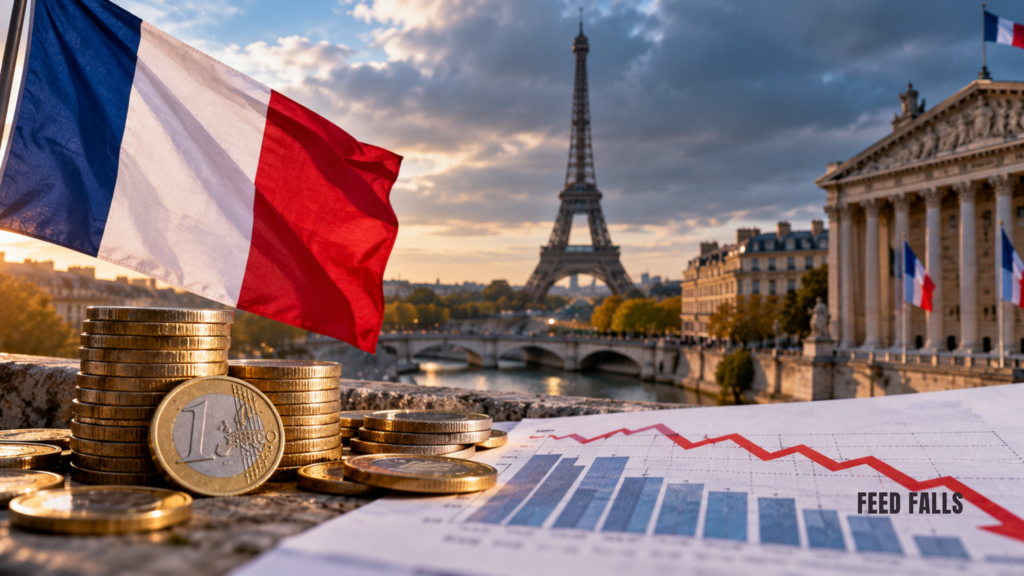
What’s going on in France is a debt crisis colliding with a political crisis and a wave of protests. France owes a record $4 trillion, about 119% of everything its economy produces in a year, and investors are now charging it the highest interest rates in more than 20 years to borrow. At the same time, protests over the cost of living and underfunded schools turned into riots in several cities on October 17.
It all comes to a head this week. The government’s 2027 budget faces its first critical vote in the National Assembly on Tuesday, October 20. If you own international stock or bond funds, or just want to understand why France keeps showing up in market headlines, here’s what’s happening and why it matters.
Why is France in a debt crisis?
France has been spending far more than it collects in taxes for years. Its budget deficit (the gap between spending and revenue in a single year) is expected to reach about 5.4% of GDP in 2026. That’s well above the 3% limit the European Union sets for its members.
Those yearly gaps add up. France’s total public debt has reached 119% of GDP, the highest level since just after World War II. The COVID pandemic and the wars in Ukraine and Iran made things worse, and critics also say President Emmanuel Macron has backed away from reforms meant to bring the debt down.
The real trigger is politics. France has gone through a string of prime ministers, and its parliament is deeply divided. Investors worry the country has become hard to govern, which makes any long-term plan to cut debt less believable.
Related: Greenland Deal: What Trump’s New U.S.-Denmark Agreement Means · Venezuela Oil Deal: What the New U.S. Agreement Means
What are bond yields, and why are France’s rising?
When France needs money, it borrows by selling bonds, which are IOUs that pay investors interest. The interest rate investors demand is called the bond yield. When investors get nervous about being paid back, they demand a higher yield.
France’s 10-year bond yield climbed to 4.989% in early October, its highest level since 2002. The extra interest investors demand to lend to France instead of Germany, which markets see as Europe’s safest borrower, widened to 1.52 percentage points. That gap, called the spread, hadn’t been that wide since the eurozone debt crisis of 2011.
Things calmed slightly after that. France’s 10-year yield eased to 4.79% on October 16. But the numbers are still flashing warning signs.
France’s debt crisis by the numbers
Here’s a quick snapshot of where things stand:
| Measure | Latest figure | Why it matters |
|---|---|---|
| Public debt | About $4 trillion, 119% of GDP | Highest ratio since the end of World War II |
| Expected debt next year | 122% of GDP | Still rising, not falling |
| 2026 budget deficit | About 5.4% of GDP | Well above the EU’s 3% limit |
| 2027 deficit target | 5% of GDP | Needs about €54 billion in tax hikes and spending cuts |
| 10-year bond yield (peak) | 4.989% in early October | Highest since 2002 |
| 10-year bond yield (Oct. 16) | 4.79% | Slightly calmer, still high |
| Spread over Germany (peak) | 1.52 percentage points | Widest since the 2011 euro crisis |
What does the spread mean in real money?
A spread of 1.5 percentage points sounds small, but it adds up fast for a country that borrows hundreds of billions every year.
Here’s a simple example. Every €100 billion France borrows at a rate 1.5 points higher than Germany pays costs about €1.5 billion more in interest each year. Over a 10-year bond, that’s roughly €15 billion extra, before counting any further rise in rates.
That money has to come from somewhere, which is why higher borrowing costs feed straight back into budget cuts, tax increases and, eventually, the kind of anger now showing up in the streets.
Why are people protesting in France?
The protests have several causes, and people disagree sharply about what should be done.
High school and university students marched earlier this month over crumbling classrooms, missing teachers and buildings not built for hotter weather. Around 400 high schools were closed on October 2. On October 17, unions, students and other groups joined nationwide protests over the high cost of living. Riots broke out in some cities, with shops looted and public buildings damaged.
Here’s how the main sides see it:
- The government says spending cuts and tax increases are needed to steady the debt and keep borrowing costs from spiraling. Prime Minister Sébastien Lecornu’s 2027 budget would trim the deficit to 5% of GDP.
- Many protesters, students and teachers argue that public services are being sacrificed to satisfy bond investors and European budget rules.
- Some economists point to a generational divide. They note that a large share of France’s spending goes to pensions, including more than a quarter of education spending going to retired teachers’ pensions, which leaves less for schools.
Who could lead France next, and why do markets care?
France’s next presidential election is in spring 2027, with a legislative election expected in June. Polls show far-right leader Marine Le Pen and far-left candidate Jean-Luc Mélenchon among the frontrunners.
Their supporters see them as offering real change after years of frustration. Bond investors are wary of both. Le Pen has pledged to roll the retirement age back to 62, which would raise pension costs. Mélenchon has proposed having the central bank cancel its holdings of French debt.
Analysts at Eurasia Group argue the market’s distrust is more political than economic, rooted in fears that neither side would make the painful cuts needed. Other analysts point out that France’s debt is still lower relative to its economy than Italy’s or Greece’s, which suggests the spread already prices in a lot of bad news.
What does France’s debt crisis mean for your money?
For most US investors, the direct effect is small, but it’s worth understanding.
If you own an international stock fund or a global bond fund, you likely hold some French companies or French government bonds. When French bond prices fall (which is what rising yields mean), funds holding them lose value. You can check your fund’s country breakdown on its fact sheet to see how much France you own.
The bigger risk is contagion, meaning trouble spreading to other countries. The situation is being compared to the eurozone debt crisis of the 2010s, which rattled global markets. Yields are also rising in Germany, the UK and the US, so a disorderly French sell-off could add pressure to borrowing costs well beyond Europe.
That’s the moment to remember the basics. As we covered in Warren Buffett’s guidance for a stock market downturn, the investors who get hurt most in a scare are usually the ones who borrowed to invest or sold in a panic. A low-cost, diversified fund, like the approach in Buffett’s S&P 500 advice, is built to ride out regional crises like this one.
If you’re traveling to France soon, we’ve also covered what the protests mean for your trip.
This article explains what’s happening and isn’t personal financial advice. If you’re unsure how much international exposure is right for you, a fee-only financial planner can review your portfolio.
What to Watch Next
- First budget vote in the National Assembly (Tuesday, October 20, 2026): If the budget fails, analysts warn borrowing costs could jump. If far-right lawmakers abstain, it could pass and buy France some time.
- National strike and demonstrations (November 5, 2026): Unions have called another nationwide day of action.
- A possible Moody’s credit rating downgrade (date not set): A downgrade would make it more expensive for France to borrow.
- Presidential election (spring 2027) and legislative election (June 2027): Markets are watching whether any winner can form a stable majority in parliament.